Pool models, construction conditions and care to help you plan your project.
In this guide 4
Application note: Chemical doses, pH/chlorine targets, run times and maintenance intervals are determined according to the product label, the measured water values, the usage class and local requirements. Numerical examples alone are not application instructions. Chemicals must never be mixed with one another; each product must be applied separately. The filter valve must only be repositioned while the pump is switched off; electrical work, pressurized equipment work and pool draining must be carried out by authorized persons in accordance with local standards. The regional water values in this article are not verified measurement data but sample planning assumptions.
Mains water of mountain origin, filtered through non-calcareous rock such as granite and basalt, can be poor in minerals and low in hardness (soft). This soft water, which poses no problem as drinking and domestic water, can behave aggressively in chemical terms once it is used to fill a swimming pool. Water that is not saturated with calcium can dissolve minerals out of cement-based grout joints, heat pump exchangers and pump components in order to establish balance (calcium hunger). For this reason, in Sermed Havuz installations it is recommended that the calcium hardness be brought into the target band according to the measurement results at the first fill. The hardness of mains water in Batumi and the Eastern Black Sea region varies by source and by season; the ppm values given here are examples only, and the mains water must be analysed individually on every project.
A pool cannot be managed without measuring the water. If soft spring water used to fill a pool is not balanced in terms of calcium, it will tend towards saturation by dissolving minerals out of the metal and cement-based components.
01. The Aggressive Character and Mineral Hunger of Soft Black Sea Water
The mineral imbalance that can be seen in pools filled with low-hardness mains water:
- Calcium Deficiency: The common target range in pool water is 200-300 ppm of dissolved calcium. In soft sources, when this value is measured it can come out far lower (as a sample assumption, 60-80 ppm); the real value can only be known through analysis.
- Dissolution (Leaching) Reaction: To make up this deficit, the water can draw calcium out of the grout filling; if the imbalance persists, disintegration of the grout joints and loss of surface material can be seen. The rate of deterioration depends on how aggressive the water is and on the grout material.
- Tendency to Foam: Very soft water can be more prone to foaming when agitated, and layers of white foam can form on the surface.
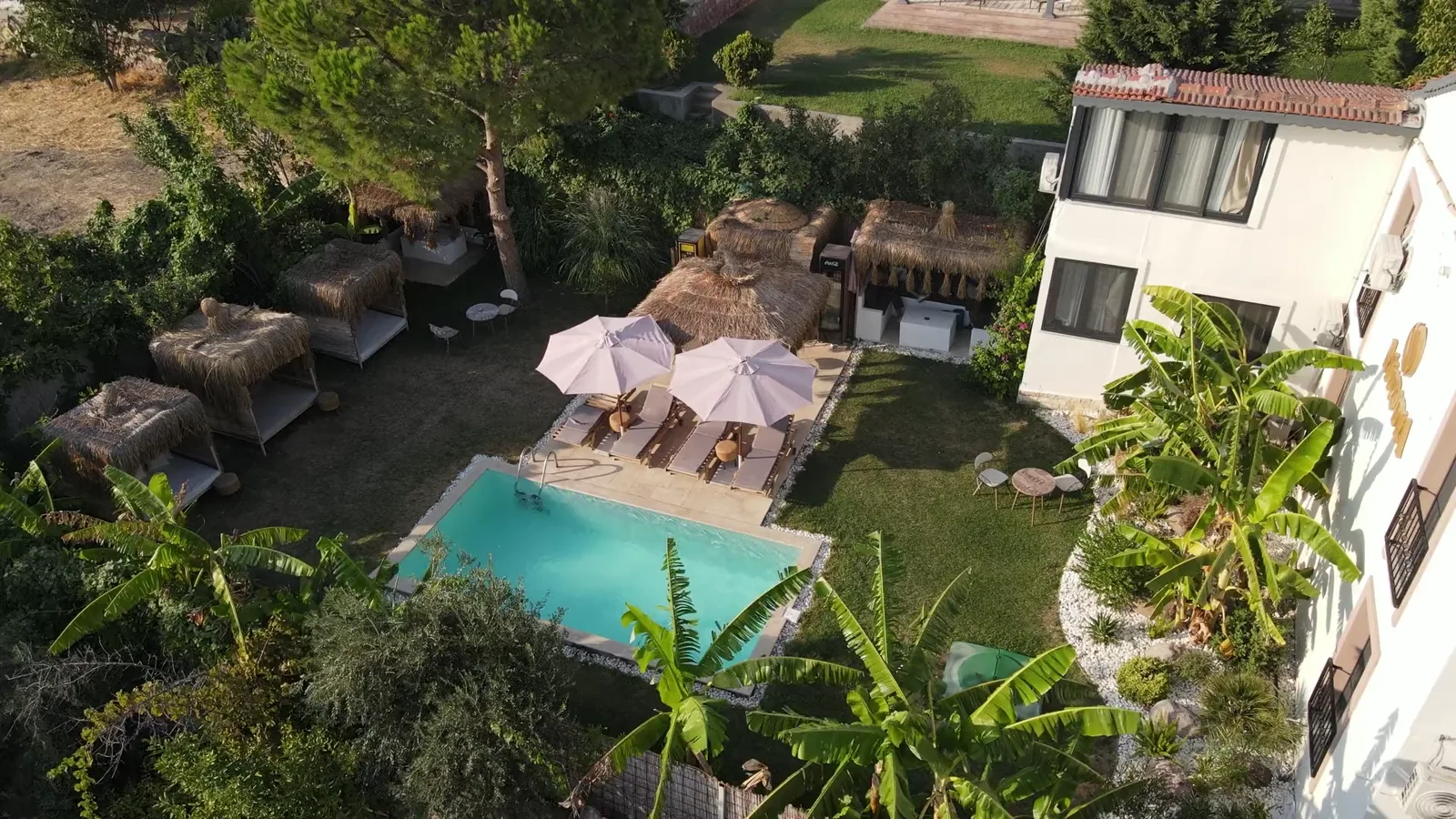 Fiplus ↗
 Maldiv ↗
 Bora ↗
02. The Severe Damage Calcium Hunger Causes to Mechanical Installations and Heat Exchangers
The effect of mineral-unsaturated water on metals:
- Wear of the Heat Pump's Titanium / Copper Exchanger: As aggressive water passes through the heater circuit it can accelerate corrosion on the metal surface; in systems run in an unbalanced state for a long time, the risk of exchanger damage and leakage increases. When damage occurs depends on the water chemistry, the temperature and the material.
- Deterioration of the Pump's Mechanical Seals: Unbalanced water can accelerate wear of the sealing gaskets on the pump shaft and thereby lead to leaks.
- Balancing With Calcium Chloride: Calcium chloride is used to bring the calcium hardness into the target band at the first fill. As a sample planning calculation, an addition on the order of approximately 1.5-2 kg of calcium chloride (77% CaCl₂) per 10 m³ of water may be required; the exact quantity must be calculated according to the measured starting hardness, the pool volume and the product label, and the addition should be made gradually with the hardness re-measured afterwards.
03. Water Hardness Values and Calcium Chloride Balancing Table
The ranges below are for general assessment; the decision to intervene is made according to the measurement results and the product label.
| Measured Calcium Hardness (ppm) | State of the Water | Effect on the Pool Installation | Intervention Required |
|---|---|---|---|
| 0 - 100 ppm (example: very soft raw water) | Extremely Soft / Aggressive | Corrosion in metals, dissolution of grout joints, tendency to foam | Measurement-based calcium chloride supplementation |
| 100 - 180 ppm | Low Hardness | The risk of corrosion persists | Calcium increaser should be considered |
| 200 - 280 ppm | Target Balance Band | The risk of corrosion decreases markedly | Generally no intervention required, continue monitoring |
| > 400 ppm | Hard Water | The tendency to deposit scale increases | Partial water replacement |
Conclusion: Filling a pool with water is not enough on its own; the hardness of the water must be measured and balanced. Keeping the calcium hardness within the target band contributes positively to the service life of the mechanical installation, provided the other conditions are suitable.
Frequently asked questions
If the calcium hardness in Batumi water is low, why does the pool water start to eat away at grout joints or equipment?
Because of chemical balance, water that is not saturated with calcium tends to dissolve calcium out of the surfaces it touches. In that case, the risk of dissolution in cement-based tile grout and of corrosion-related wear in pump components and the heat pump exchanger increases. Since the actual hardness of the water varies with the mains source, no assumptions should be made without an analysis.
Does calcium chloride damage the liner?
When used in accordance with its label, dissolved first in water in a separate bucket and then distributed evenly through the pool, it is a suitable application as far as the liner is concerned; it must not be poured dry directly onto the liner and must not be mixed with other chemicals. Reducing the aggressiveness of the water is also beneficial for the liner and the other surfaces.
If well water is used, will the calcium hardness still be low?
In well water the calcium value is variable; minerals such as iron and manganese can also come out high. For this reason a water analysis must always be carried out before the pool is filled.
Should the calcium level be measured every month?
Calcium does not evaporate away; once it has been balanced at the start of the season, it is appropriate to check it after heavy rainfall, overflow or significant water replacement. The measurement frequency is determined by the intensity of use and the amount of water loss.