Pool models, construction conditions and care to help you plan your project.
In this guide 4
Application note: Chemical dosages, pH/chlorine targets, operating times and maintenance intervals are determined according to the product label, measured water values, the usage class and local requirements. Numerical examples are not, on their own, application instructions. Chemicals must never be mixed with one another; electrical work, pressurized equipment and pool draining operations must be carried out under expert supervision.
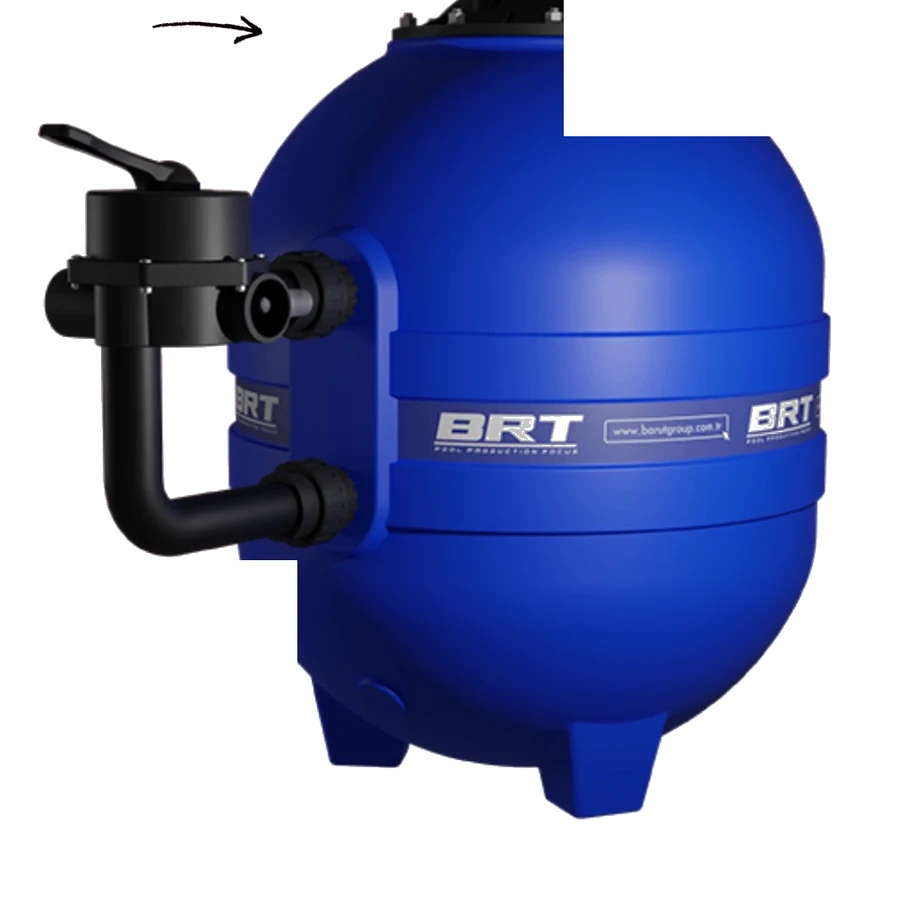
The efficiency of pool filtration depends on periodically expelling from the system the dust, pollen, hair and organic sediment that accumulate in the filter tank. The most common operating mistakes users make are going for months without backwashing, never once checking the filter pressure gauge, or turning the valve handle while the pump is running and thereby damaging the internal gasket of the multiport valve. A clogged filter markedly reduces the water flow rate, preventing the water from clearing, and can cause the pump to labour. The Sermed Pools operating manual is based on the Backwash protocol applied when the pressure gauge reading rises about 0.3 bar above the clean filter value, followed by a short Rinse. The durations below are typical application ranges; the equipment manufacturer's manual takes precedence.
Cleaning the filter is not hours of labour but a simple hydraulic redirection job completed in a few minutes by moving the multiport valve to the correct positions.
01. The Hydraulic Burden of a Clogged Filter: Flow Loss and Pump Overheating
The following problems can develop when backwashing is neglected:
- A Rising Pressure Gauge Reading: The initial pressure measured with a clean filter (which in many systems can be in the order of
0.8 – 1.0 bar) rises as the media becomes dirty. The initial pressure differs in every installation and should be recorded during commissioning; monitoring is then done against that record. Increased pressure causes the pump to labour and energy consumption to rise. - Weakening Nozzle Thrust: Because the flow rate of clean water delivered into the pool drops, circulation within the pool weakens and sediment accumulates on the floor.
- Turning the Valve Handle With the Pump Running: This is a common user error; pressurized water can damage the valve gasket (the spider gasket), which can result in leakage and allow filter media to pass into the pool.
 Fiplus ↗
 Maldiv ↗
 Bora ↗
02. The Sermed Pools Step-by-Step Backwash Protocol: The Pump Shutdown Rule and the Sight Glass
Backwashing should be carried out in the following sequence of steps:
- Step 1: Switch off the circulation pump at the electrical panel (this is essential!).
- Step 2: Press down the multiport valve handle and move it to the "BACKWASH" position; open the drain valve.
- Step 3: Start the pump. Water enters in reverse and fluffs up the media bed; the water flowing past the sight glass beside the valve looks cloudy at first, and once the flowing water runs clear (typically 2–3 minutes) the pump is switched off.
- Step 4: Move the valve handle to the "RINSE" position.
- Step 5: Run the pump for approximately 30–45 seconds; the media bed settles back into place and the dirty water in the pipes is sent to the drain, after which the pump is switched off.
- Step 6: Return the valve handle to the "FILTER" position and switch the pump on to resume normal filtration.
03. Six-Way Valve Positions and Function Table
| Valve Position | Direction of Water Flow | When Is It Used? | Duration / Caution |
|---|---|---|---|
| FILTER | Strains downwards through the media | In normal daily filtration | The continuous operating position |
| BACKWASH | Washes the media from the bottom upwards | When the pressure gauge rises about 0.3 bar above the initial value | 2 – 3 minutes (until the water runs clear) |
| RINSE | Settles the media downwards | Immediately after backwashing | 30 – 45 seconds (must not be skipped) |
| WASTE | Straight to the drain, bypassing the media | Vacuuming the floor, extreme cloudiness, or lowering the level | Change position with the pump off; the water level must be monitored |
| RECIRCULATE | Delivers straight to the pool without filtering | When circulation is needed with the filter bypassed | Chemicals must never be mixed with one another; each product is applied separately and diluted according to its label |
| CLOSED | Locks off all water passage | For winterizing or cleaning the pump strainer basket | DO NOT RUN THE PUMP |
Conclusion: The backwash and rinse cycle is the foundation of regular maintenance for the filtration system. The few minutes you set aside to monitor the pressure gauge are the most practical way to keep water quality high.
Frequently asked questions
When the pool filter pressure gauge shows a rise in pressure, how many minutes should backwashing be applied for?
Backwashing should be carried out when the gauge needle reaches a level roughly 0.3 bar above the initial pressure you recorded with a clean filter. The operation continues until clear water flows past the sight glass; this is typically 2–3 minutes. A rinse of 30–45 seconds then follows. The durations in the equipment manufacturer's manual should take precedence.
What happens if the rinse step is skipped?
If the valve is returned to the filter position immediately after backwashing, the dirty water and fine particles left on top of the media bed can pass through the nozzles into the pool and cloud the water; the rinse sends this water to the drain and lets the bed settle back into place.
How much water does the pool lose during backwashing?
The volume of water discharged depends on the filter diameter, the pump flow rate and the duration of the operation. A sample calculation: in a system running at 8 m³/hour, a 3-minute backwash corresponds to roughly 400 litres of water (8,000 litres/hour ÷ 60 × 3). You can run the same calculation with your own system's flow rate. Once the operation is complete, the water lost should be topped up with fresh water and the water balance measured again.
What breaks if the pump is left running while the valve handle is turned?
If the valve handle is turned with the pump running, pressurized water can damage the spider gasket inside the valve; the valve can start to leak and filter media can pass into the pool. The pump must always be switched off electrically before the handle is turned.