Pool models, construction conditions and care to help you plan your project.
In this guide 4
Application note: Chemical doses, pH and chlorine targets, run times and maintenance intervals are determined by the product label, measured water values, the usage class and local requirements. Numerical examples are not, on their own, application instructions. Chemicals must never be mixed with one another; electrical work, pressurized equipment and pool draining must be carried out under expert supervision.
The heavy smell and red eyes that swimmers most often notice, and usually interpret as "there is far too much chlorine in this pool", are in most cases a misdiagnosis. In terms of pool chemistry, the more likely explanation is this: the heavy smell generally comes not from excess chlorine but from Combined Chlorine (Chloramine) compounds that build up in the water because free chlorine is insufficient. When free chlorine reacts with the nitrogen compounds found in swimmers' sweat, urine and cosmetic residues, it turns into chloramines. If there is not enough free chlorine in the pool, these compounds cannot be broken down adequately and a layer of gas that irritates the eyes and the respiratory tract can accumulate in the zone just above the water surface. In this article we explain the two approaches used to reduce chlorine odour: breakpoint shock chlorination and UV-C photolysis. Interventions applied without measurement will not solve the problem permanently; in every pool, water analysis must come first.
Contrary to popular belief, a heavy chlorine smell and eye irritation in a pool are generally caused not by excess chlorine but by Combined Chlorine (Chloramine) compounds that accumulate because free chlorine is insufficient. When chlorine combines with nitrogen compounds from sweat and urea in the water, it turns into chloramines, which irritate the eyes and give off a sharp smell. In this situation the solution is not to cut out chlorine altogether; it is to carry out breakpoint shock chlorination based on the measured results, or to support the breakdown of chloramines with a UV-C system.
A well balanced pool water is not expected to have a noticeable smell. A heavy chlorine odour is not a sign that the water is well disinfected; it is a sign that the chemical balance needs to be checked.
01. Free Chlorine vs. Combined Chlorine: How Chloramines Form and Why They Smell
The two different states of chemical chlorine in water:
- Free Chlorine: Chlorine that has not yet bonded to organic matter in the water and is still active for disinfection. The target range is determined by the usage class, the product label and local requirements; the commonly cited reference range is around 1.0 to 2.0 ppm.
- Combined Chlorine (Chloramines): When chlorine combines with ammonia and nitrogen-based contamination in the water, it turns into mono-, di- and trichloramine compounds; these irritate the eyes and throat and produce a sharp smell. The reference upper limit frequently used in operating practice is around 0.2 ppm; for a binding limit, local regulations take precedence.
 Fiplus ↗
 Maldiv ↗
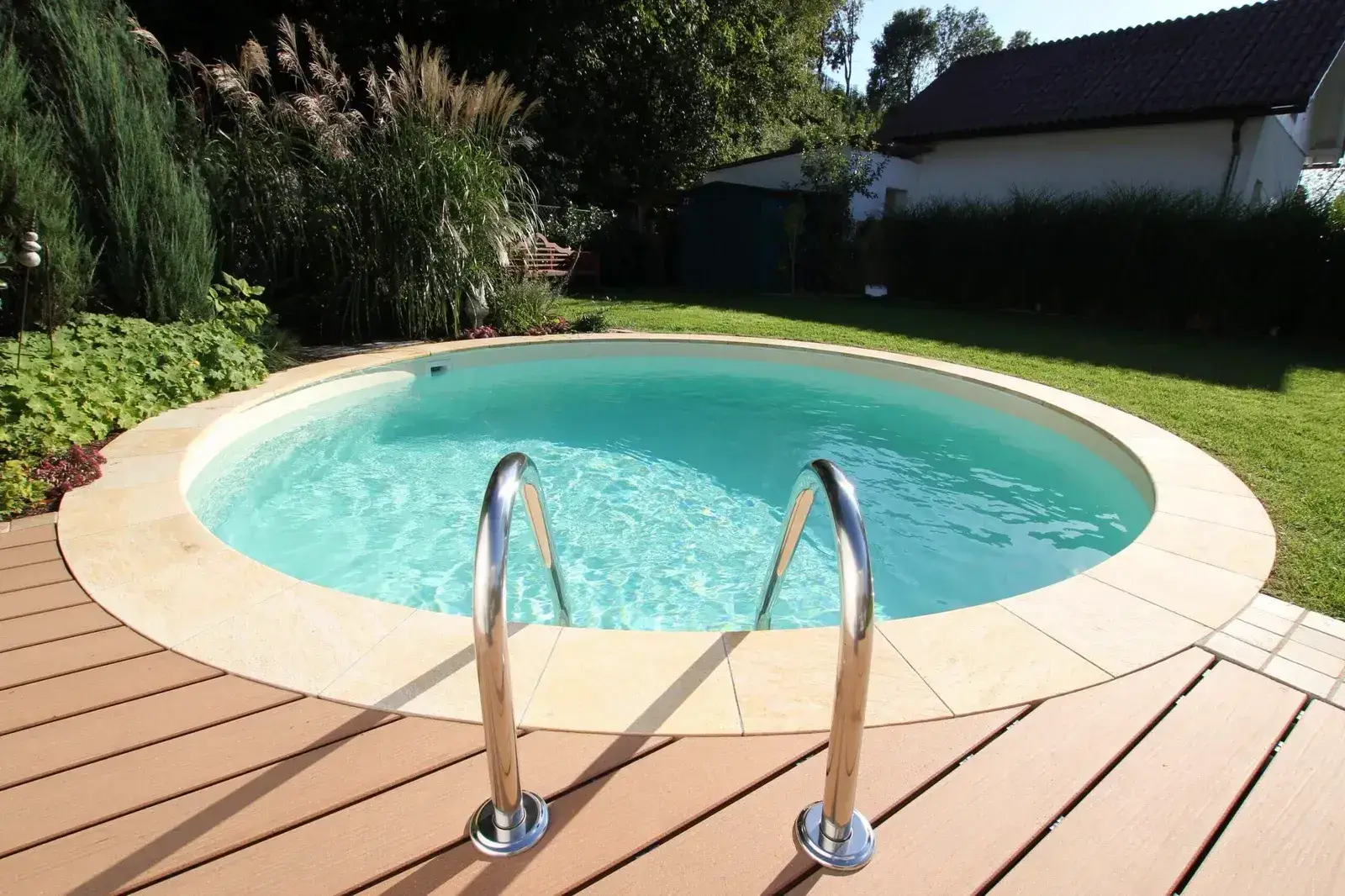 Bora ↗
02. Breakpoint Chlorination and the UV-C Solution
Two common ways of reducing the chloramine load:
- Breakpoint Chlorination:
Target Shock Chlorine Level ≈ Combined Chlorine Value (ppm) × 10
This multiplier is a planning reference widely used in the industry and must be confirmed against the measured water values and the product label. For example, when combined chlorine is measured at 0.5 ppm, the aim is a shock dose that raises free chlorine to roughly 5 ppm. At a sufficient free chlorine level, a significant proportion of the chloramine compounds can be oxidized all the way to nitrogen gas, and the smell decreases noticeably. The outcome varies with water temperature, contamination load, pH and stabilizer level; no one should enter the pool until the chlorine level has fallen back into the safe range after treatment. - UV-C Ultraviolet Reactor: A 254 nm UV-C lamp fitted into the filtration line breaks down part of the chloramines in the water passing through the reactor by means of photolysis. This is a supporting method that helps reduce the chemical load and the odour; it does not remove the need for a residual chlorine disinfectant, and its efficiency depends on flow rate, lamp power and lamp age.
03. Chlorine Types and Health Effects Table
| Chlorine Type | Reference Limit Value | Odour and Eye Irritation | Role and Function |
|---|---|---|---|
| Free Chlorine (HOCl) | 1.0 – 2.0 ppm (common reference) | When kept in balance, no noticeable odour or eye irritation is expected | The active disinfectant that acts on microorganisms |
| Combined Chlorine (Chloramines) | < 0.2 ppm (common reference upper limit) | The main source of the sharp smell and eye irritation | A by-product formed when chlorine combines with nitrogen-based contamination |
| Total Chlorine | Free + Combined Chlorine | - | The overall total measured by the test kit |
Conclusion: if there is a sharp smell in your pool, start with a water analysis; based on the results, apply shock treatment to reduce combined chlorine or consider a treatment set-up supported by UV-C.
Frequently asked questions
How is the combined chlorine value measured?
Free chlorine is measured with a DPD1 tablet, then total chlorine with a DPD3 tablet; the result is found with the formula Total Chlorine - Free Chlorine = Combined Chlorine. If the difference is above the 0.2 ppm level used as an operating reference, there is a significant build-up of chloramines.
Is opening the windows enough when the pool smells?
Adequate ventilation is essential in indoor pools, but ventilation alone does not reduce the combined chlorine load in the water. Since the source is the chloramines in the water, the lasting solution is to correct the water chemistry.
Can a chloramine smell occur in saltwater pools?
Because salt electrolysis cells continuously feed the water with freshly generated chlorine, combined chlorine build-up generally stays more limited. Even so, with a high bather load, insufficient cell capacity or a faulty generator, a chloramine smell can also develop in saltwater pools; measurement is still necessary.
Do chloramines damage the liner?
Chemical and organic residues that accumulate at the waterline, together with unbalanced chlorine levels, can over time contribute to colour fading on the liner surface and to the membrane losing its flexibility. The extent of the effect varies with chlorine level, pH, UV exposure and membrane quality.