Pool models, construction conditions and care to help you plan your project.
In this guide 4
Project note: The foundation thicknesses, concrete classes, reinforcement, excavation allowances, pipe diameters and quantities mentioned in this guide are preliminary planning examples and have the character of manufacturer reference details; they do not constitute a structural design that can be applied to every site. The design must be prepared by a qualified engineer after evaluating the geotechnical investigation, the groundwater level, the loads and local regulations. A full pool can also be affected by external hydrostatic pressure; if the external water load exceeds the internal water load, liner floating and damage to the shell can occur even in a full pool. Draining, drainage and electrical work require specialist supervision. This text does not present verified groundwater depth, rainfall figures or local regulatory data for Batumi; the numerical values given are illustrative examples.
The New Boulevard and the airport axis of Batumi, where villa and residence development is concentrated, lie close to delta and coastal fill areas; young alluvial layers may be encountered in districts of this kind. However, the soil profile of a plot can only be established through a geotechnical investigation carried out on that particular plot. On saturated, silty soils that may contain organic matter, pouring concrete directly onto the ground without preparation increases the risk of differential settlement and of the base slab remaining permanently damp. At Sermed Pools, on soils of this kind and subject to the approval of the project engineer, we take as our reference the use of washed crushed stone (gravel bedding), a polyethylene moisture barrier and a base slab reinforced with steel mesh.
Building a pool on an alluvial delta is not a matter of draining a marsh; it is a matter of seating the pool shell on a properly sized raft foundation. A correctly designed gravel bed significantly reduces the capillary contact between the ground water and the pool shell.
01. Low Bearing Capacity and Capillary Rise in Saturated Alluvial Soils
Geological soil investigations carried out along the coastal belt may show that the upper layers in such areas can contain loose sand, silt and marine mud; the thickness and depth vary from plot to plot and are established by investigation. The mistakes most frequently encountered when building pools on these sites are as follows:
- Pouring Concrete Directly Without a Gravel Bed: The underside of concrete poured onto muddy ground can remain porous and, because of contamination and water loss, may fail to reach the intended strength.
- Capillary Rise (Capillarity): Fine grained silty soils draw water upward. A base slab without a gravel bed stays permanently damp, which increases the corrosion risk for the steel reinforcement inside it.
- Differential Settlement and Twisting of the Shell: Alluvial soil may not respond uniformly under the pool load; one end of the pool may settle more than the other, which can distort the water line. The expected amount of settlement can only be predicted through a geotechnical investigation and structural calculation.
- Heave of the Excavation Base: Once the excavation is opened and the soil load above it is removed, pressurized groundwater below can push the base upward.
 Fiplus ↗
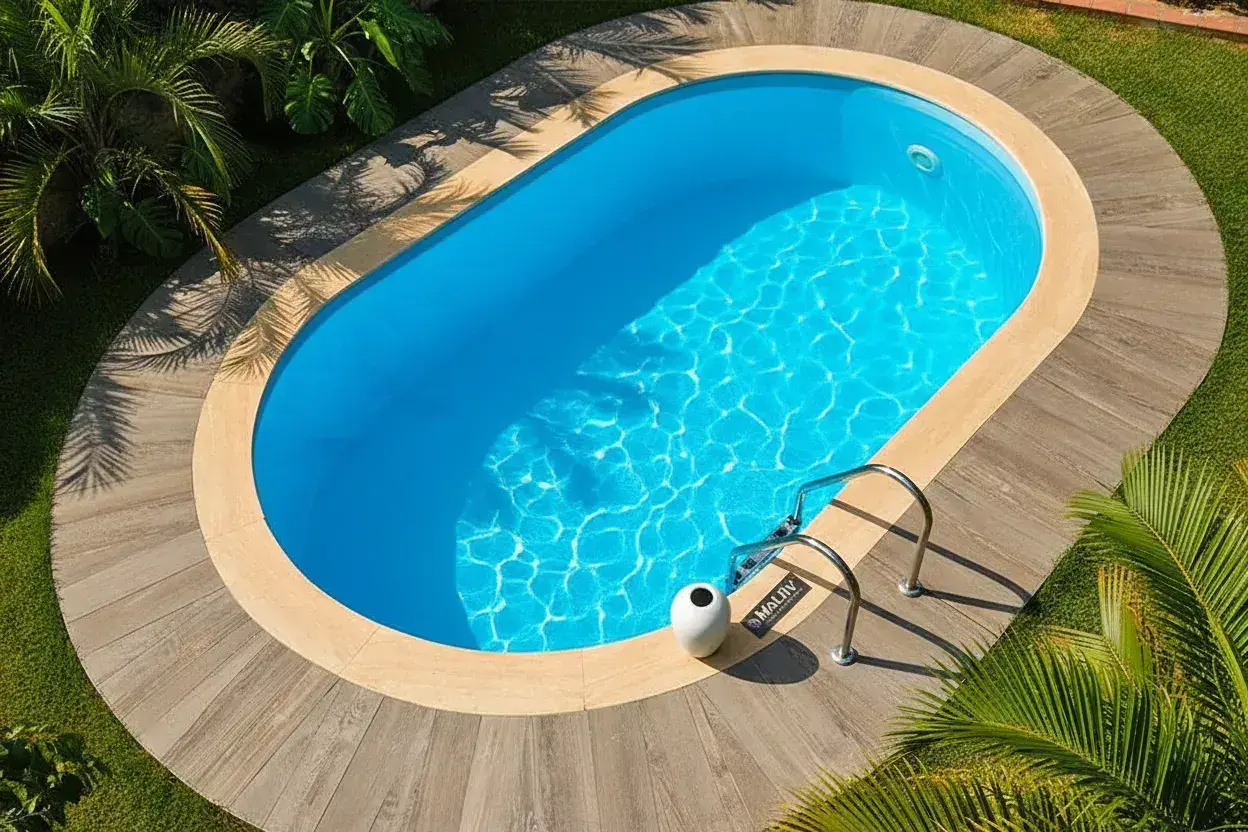 Maldiv ↗
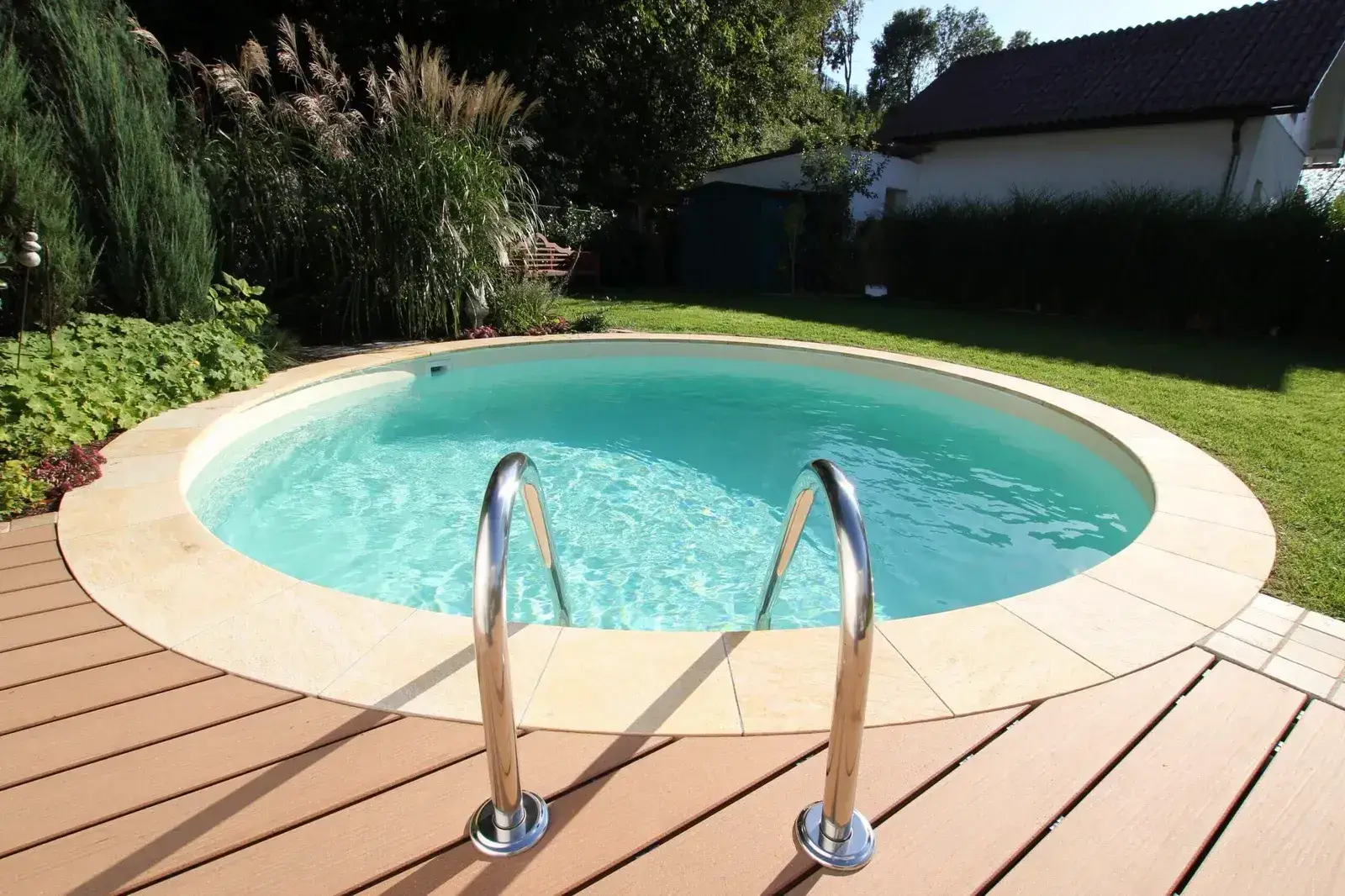 Bora ↗
02. Sermed Pools Base Preparation: Gravel Bedding, Geotextile and Drainage Pipe Reference
Sermed Pools site practice is based on a layered bedding system on saturated sites; the final thicknesses and the choice of reinforcement vary according to the structural design:
- Geotextile Separation Fabric: Geotextile fabric (example weight: 200 g/m²) is laid over the excavation base. This fabric helps to reduce the mixing of the crushed stone laid on top of it with the soft soil below.
- 15-20 cm of Washed Crushed Stone (Gravel Bedding): A layer of clean crushed stone with a grain size of 16-32 mm is spread and compacted with a mechanical compactor. This layer largely cuts off capillary rise and forms a drainage bed. The thickness may be increased by the engineer according to the soil conditions.
- Base Drainage Piping: Ø100 mm perforated drainage pipes laid at the lower level of the gravel bedding carry the accumulated water to a suitable discharge point or inspection chamber. The adequacy of the discharge point and the local permit situation must be assessed in the design.
- 20 cm C30 Raft Slab with Q131 Reinforcement (Reference Detail): A polyethylene vapor barrier is laid over the gravel bedding, steel mesh reinforcement is placed on cover spacers and ready mixed concrete is poured. The values of 20 cm C30 and Q131 are a manufacturer reference foundation detail; they are not a universal recipe valid for every soil and may be modified according to the geotechnical and structural design of the site.
03. Layer Thicknesses and Structural Function Table for Alluvial Soils
| Foundation Layer | Material and Reference Thickness | Soil Mechanics Function | Risk If It Is Omitted |
|---|---|---|---|
| Soil Separator | 200 g/m² Non-Woven Geotextile Fabric | Reduces the mixing of the soft soil with the crushed stone | The crushed stone sinks into the soil and the function of the drainage bed diminishes over time |
| Capillary Break Bedding | 15-20 cm Crushed Stone (16-32 mm) | Cuts off capillary rise, distributes the load | The base slab may remain permanently damp and the risk of reinforcement corrosion increases |
| Vapor Barrier Membrane | 0.20 mm Polyethylene Construction Sheeting | Prevents cement grout from escaping into the crushed stone | Mixing water is lost, hydration is adversely affected and the risk of cracking increases |
| Load Bearing Reinforcement | Q131 Steel Mesh (single or double layer according to the structural design) | Resists tensile and bending stresses | Risk of cracking and fracture in the base slab during ground movement |
| Load Bearing Raft Concrete | Reference 20 cm C30 Class Ready Mixed Concrete | Rigid ground platform that carries the pool frame | Risk of deviation from plane and distortion of the level and coping line |
Conclusion: On saturated alluvial soils, the critical component of pool construction is the preparation layer beneath the base slab. In systems installed without suitable bedding and drainage, the long term performance risk increases regardless of the pool type; the scope of the warranty, meanwhile, depends on the product type and the written warranty conditions.
Frequently asked questions
Why should crushed stone or lean concrete be laid under the base slab on saturated alluvial soils close to coastal fill?
On soils of this kind, water can climb upward through capillary paths and the bearing capacity of the ground may be low. A 15-20 cm layer of crushed stone (gravel bedding) both breaks the capillary rise and distributes the pool load more evenly into the ground, reducing the risk of differential settlement. The required thickness and the actual load of the pool (obtained by adding together the water volume and the weight of the shell and the finishes) must be calculated in the design.
What happens to the gravel bedding if geotextile fabric is not laid?
On soft clayey and silty soils, if no geotextile is laid, the crushed stone placed on top can gradually sink into the fine grained soil under vibration and water flow, and the function of the drainage layer diminishes.
Can sea water seep into the excavation pit at New Boulevard?
On plots close to the shore, the ground water may well be saline or brackish in character; however, in order to give a definite limit based on distance, a water sample must be taken and analyzed on that particular plot. If the analysis shows chloride or sulfate aggressiveness, the concrete class and admixtures must be selected accordingly, and the reinforcement cover must be increased in the structural design.
Can a compactor be used while compacting the gravel bedding?
Yes; after the crushed stone has been spread in layers, it should be compacted with a vibrating compactor or roller of suitable capacity. Gravel left loose can settle after the concrete has been poured.