Pool models, construction conditions and care to help you plan your project.
In this guide 4
Project note: The base thickness, concrete class, reinforcement, excavation allowance, pipe diameter and quantities given in this guide are preliminary planning examples; they do not constitute a structural design that can be applied to every site. The design must be prepared by a qualified engineer after evaluating the geotechnical investigation, groundwater, loads and local regulations. Even a full pool can be affected by external hydrostatic pressure; emptying, drainage and electrical work require expert supervision.
Along the Chakvi, Buknari and Tsikhisdziri corridor, where former tea and citrus plantations are being converted into villa plots, one of the most frequent mistakes when building a pool is to carry on with construction without stripping the organic agricultural topsoil, or to backfill that same soft soil around the pool. Organic ground full of plant roots can lose water under load and compress, which may cause differential settlement in the pool base and cracking of the sunbathing terraces around the pool. The stripping depth (commonly observed in the order of 50 to 80 cm on most plots) is not a fixed rule; it is determined according to the geotechnical investigation data, going down until firm mineral ground is reached. In Sermed Havuz practice, stripping the topsoil and maintaining discipline in mechanical compaction and crushed stone backfill is adopted as a basic site rule.
The loose, well aerated structure that soil needs in order to be farmed is an undesirable property in load-bearing ground. If you are going to place a pool in your garden whose filled weight runs into tens of tonnes (example: a 4x8 m pool with an average depth of 1.40 m holds roughly 45 m3 of water, meaning a water load of about 45 tonnes; the loads of the shell and the finishes are accounted for separately), you need to separate the rules of soil mechanics from the habits of growing plants.
01. Differential Settlement and Deck Collapse in Organic Agricultural Ground
Because of their porous structure, Adjara's fertile red and brown forest and agricultural soils can carry the following risks under pool loads:
- Decay and Volume Loss of the Topsoil: A layer of organic roots and humus left at the base of the excavation can decompose as it is deprived of air beneath the concrete. The decomposing organic matter leaves voids behind, and the base slab may settle at isolated points.
- Voids Forming Around the Terrace: If the gap between the pool frame and the edge of the excavation is backfilled with the clayey agricultural soil taken from the excavation, that soil may compress and settle with the first rains. The ceramic tiles and composite decking at the pool edge are then left unsupported and can break when stepped on.
- The Swelling and Shrinkage Cycle: Clayey agricultural soils shrink as they dry out in summer and expand as they take on water in the rainy season, applying lateral thrust to the pool panels. The rate of expansion depends on the mineralogy of the clay and on moisture variation; a single percentage figure is not valid for every soil, and where necessary it is determined by a laboratory swelling test.
- Inadequate Compaction (Backfill Without Rolling): Tipping the backfill into the excavation in one go without tamping it can cause settlement to continue over a period of years.
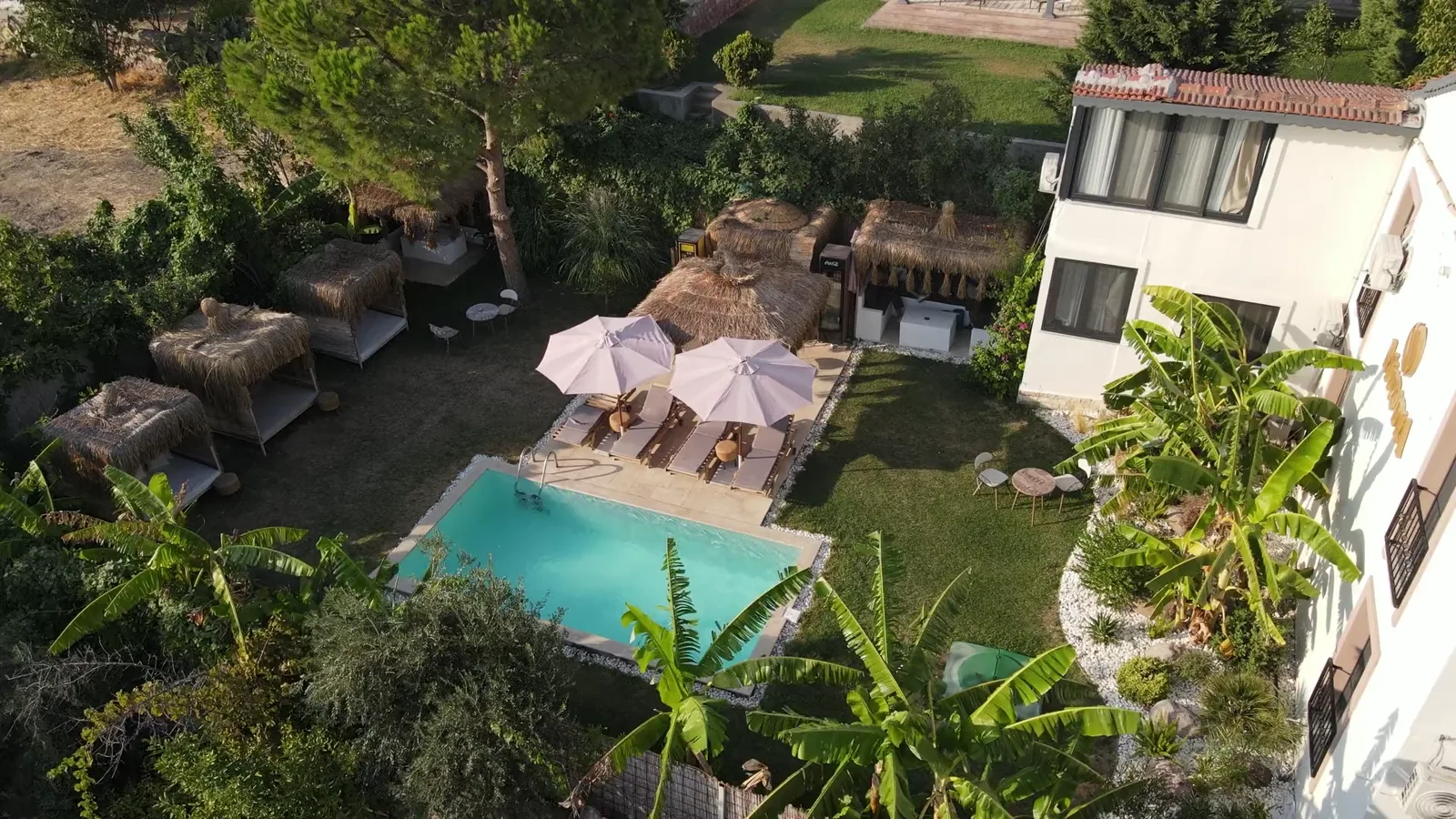 Fiplus ↗
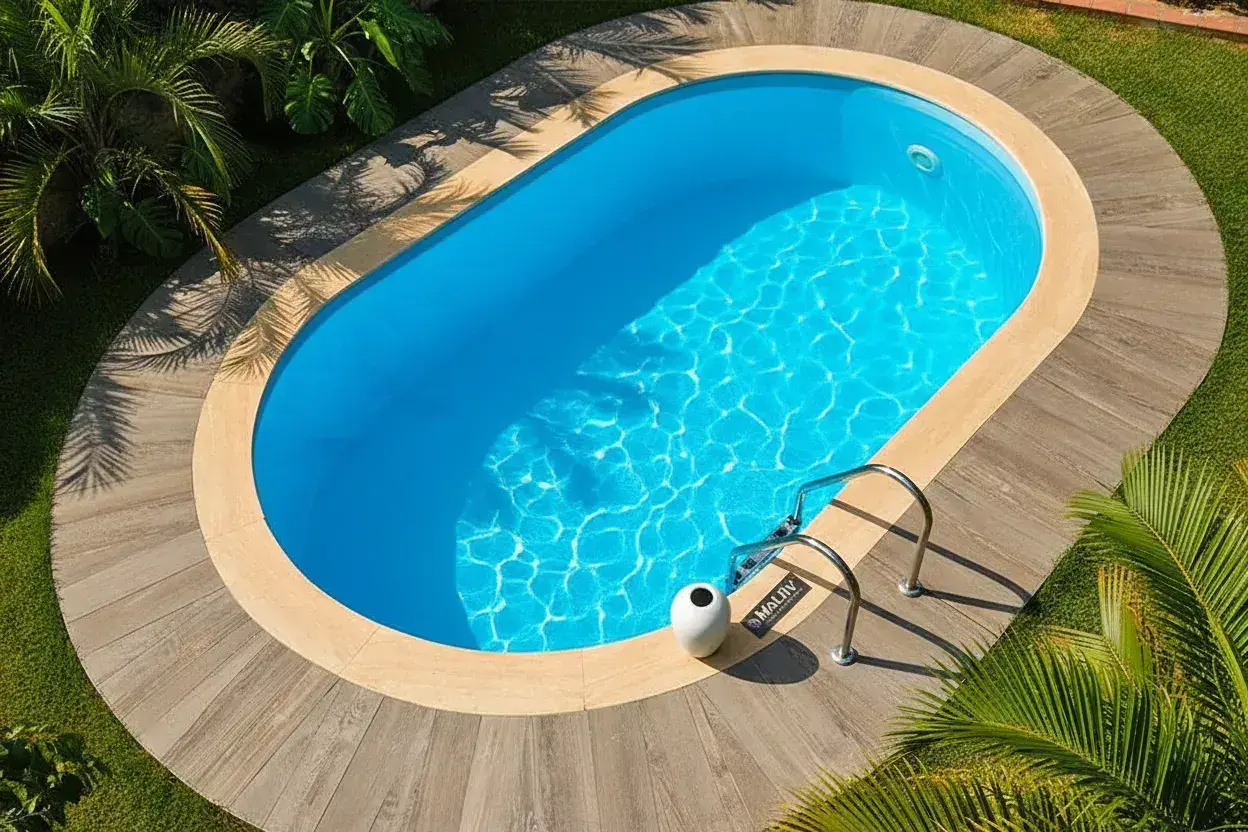 Maldiv ↗
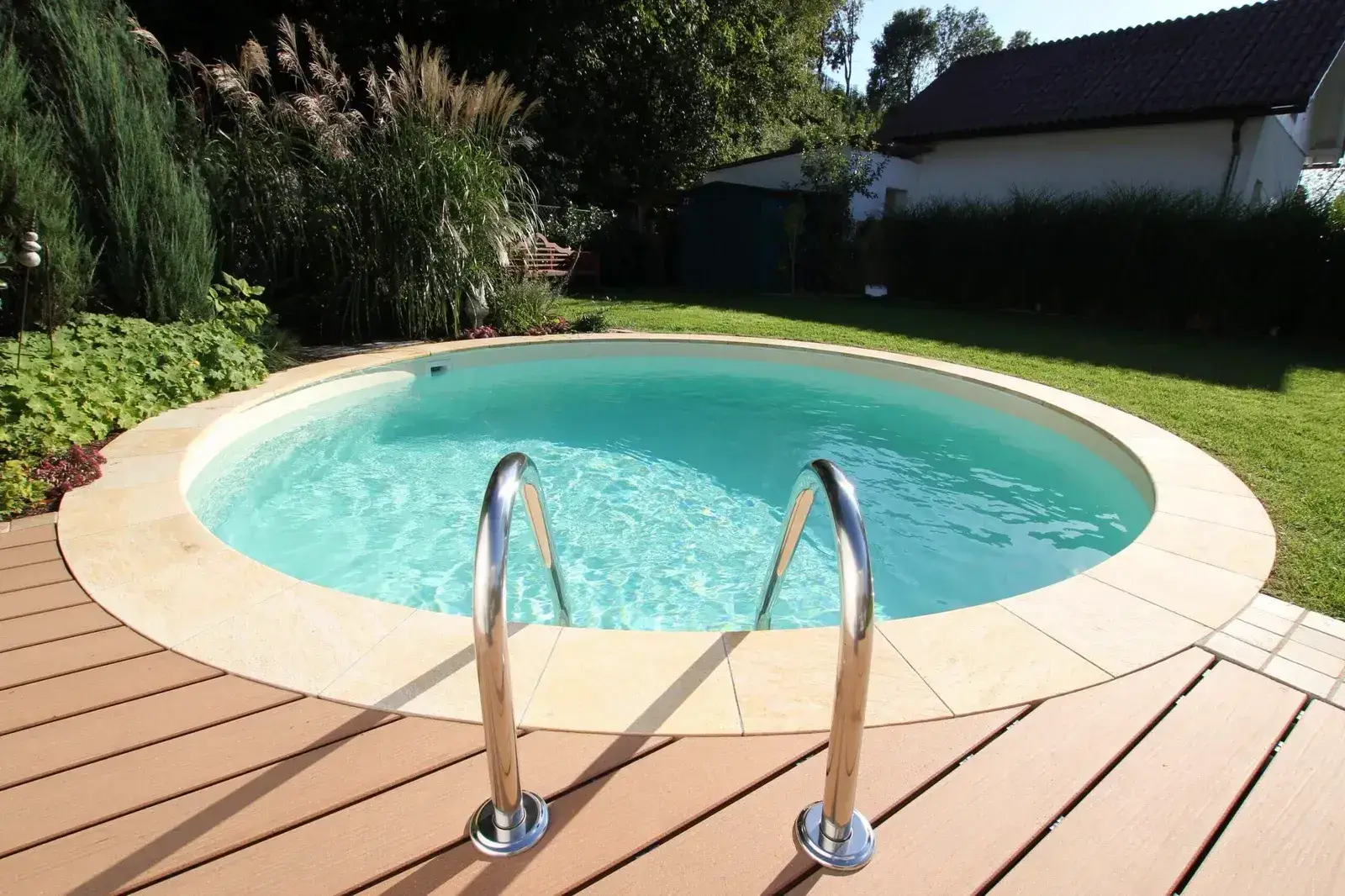 Bora ↗
02. The Sermed Havuz Site Standard: Topsoil Stripping and Layered Compaction
The Sermed Havuz site manual is based on the following four-stage approach to groundworks on Chakvi agricultural land; the final values are confirmed by the project engineer according to the results of the geotechnical investigation:
- Complete Stripping of the Topsoil Layer: During excavation the humus-rich topsoil at the surface is dug out, removed from the pool area and stockpiled for later use in the landscaped areas. The excavation is taken down to the firm mineral soil layer; this depth varies from plot to plot.
- Staged Mechanical Compaction: The base of the excavation is compacted with a vibratory roller or plate compactor until it reaches the compaction target set by the design (a commonly used reference is 95% Standard Proctor). The weight of the machine and the number of passes are chosen according to site conditions.
- Crushed Stone Backfill and a Dry Mortar Shield: The area around the pool panels is not backfilled with agricultural soil. Washed 10 to 20 mm crushed stone or a lean dry mortar is used instead. This backfill is raised in stages, tamped in layers of roughly 30 cm.
- External Diagonal Braces and Locking into the Raft Slab: In the Fiplus system the pool shell is made up of 20 mm F-Stone fibre cement panels; lateral load transfer is handled separately from the shell, by galvanized steel external diagonal braces. In the reference detail these braces are anchored into a 20 cm C30 / Q131 base slab. This detail is the manufacturer's reference solution; it is not a universal recipe to be applied directly on every type of ground, and it must be confirmed against the site's geotechnical and structural design.
03. Ground Improvement and Backfill Strength Table for Agricultural Ground
| Groundwork Stage | Faulty Site Practice | Sermed Havuz Engineering Standard | Effect on Structural Safety |
|---|---|---|---|
| Topsoil Management | Work continues on top of the topsoil without excavating it | The upper humus layer is stripped off completely | Reduces the risk of base settlement caused by organic decomposition |
| Base Compaction | No compaction is carried out, the ground is simply patted down with the excavator bucket | The compaction target set in the design is achieved with a vibratory compactor (e.g. 95% Proctor) | Improves bearing capacity and settlement behaviour; the degree of improvement varies with the soil and is established by calculation |
| Backfill Material | Muddy tea-plantation soil taken from the excavation | 10 to 20 mm crushed stone aggregate or dry mortar | Markedly reduces the risk of settlement in the surrounding walkways |
| Backfill Compaction Method | Filled in one go and flooded with water | Staged tamping every 30 cm | Aims to reduce settlement of the fill over time |
| Service Life of Landscaping and Terraces | Joints opening up early and decking warping | Level stability is targeted through correct backfill and compaction | Aims to reduce the investor's maintenance and repair costs |
Conclusion: the key to building a pool on the old tea fields of Chakvi is to keep the topsoil and the pool shell apart from one another. Crushed stone backfill and a properly designed base slab are intended to give your garden terrace a long service life.
Frequently asked questions
When backfilling after a pool excavation on former agricultural land, how should the material be rolled so that the soil does not settle?
The backfill should not be carried out with the clayey agricultural soil taken from the excavation. The area around the panels should be filled with screened 10 to 20 mm crushed stone or dry mortar and raised stage by stage, compacted with a hand compactor in layers of roughly 30 cm. The layer thickness and the number of passes are determined by the equipment used and by the project specification.
What harm does it do to the pool if the organic topsoil is not stripped?
Topsoil holds a large amount of water and air within its structure. The water load created once the pool is filled (for example about 45 tonnes in a 45 m3 pool) gradually forces that water out, and the soil loses volume and settles; this can lead to cracking in the base slab or to the pool losing its level.
How long should you wait for the backfill to settle before pouring concrete around the pool?
When the correct material (crushed stone aggregate) is used and compacted layer by layer, the need for a waiting period is significantly reduced; even so, the appropriate waiting time, or whether the concrete can be poured straight away, is a decision for the project engineer once compaction checks have been carried out. No blanket undertaking can be given that the pour can be made the following day on every site.
Is it necessary to have a compaction test (Proctor test) carried out?
For large-scale commercial hotel pools, or on sloping agricultural hillsides, it is advisable to have the degree of compaction measured using accredited laboratory methods. At villa scale too, a geotechnical investigation together with site supervision is the most reliable basis for the design.