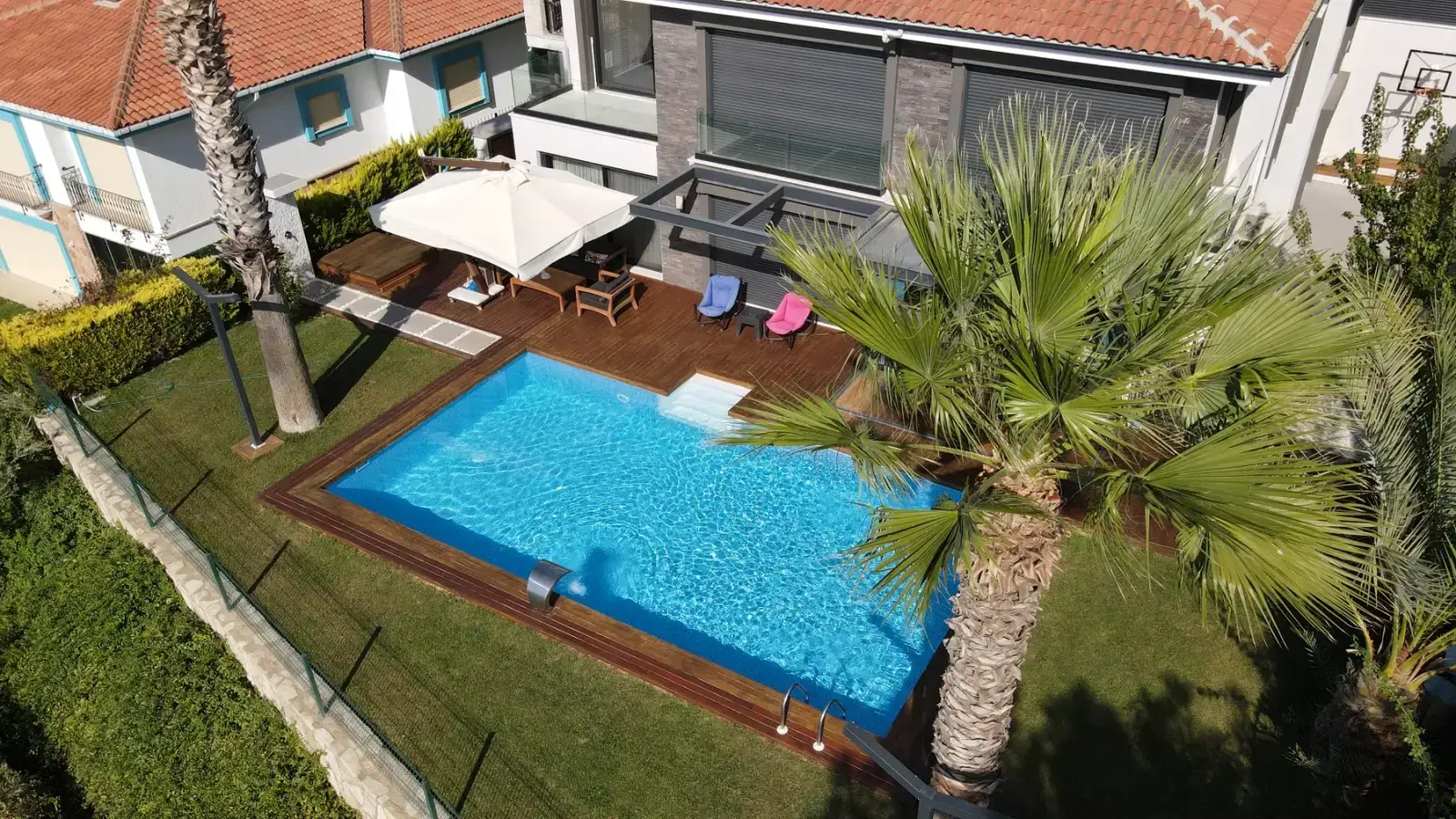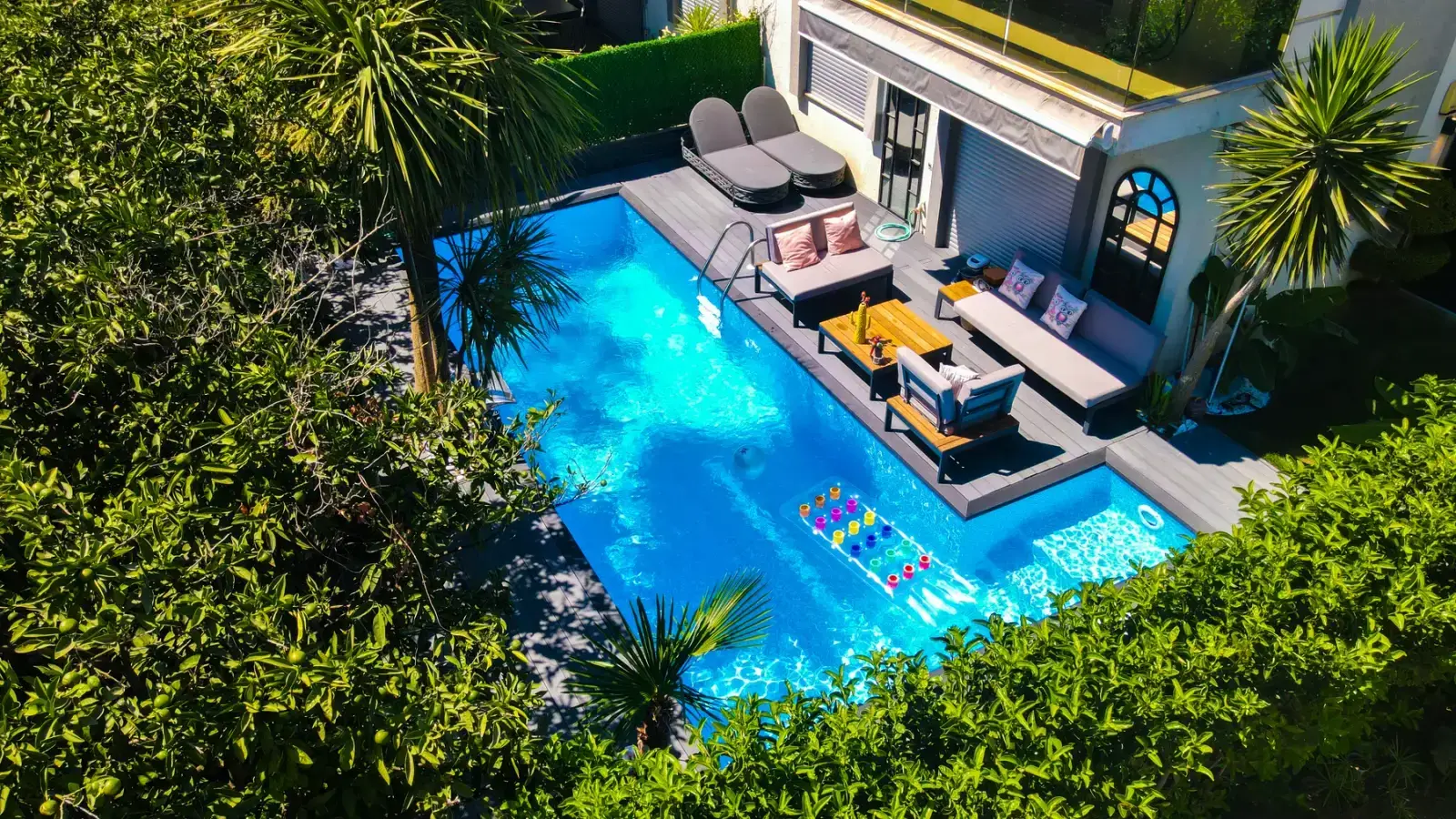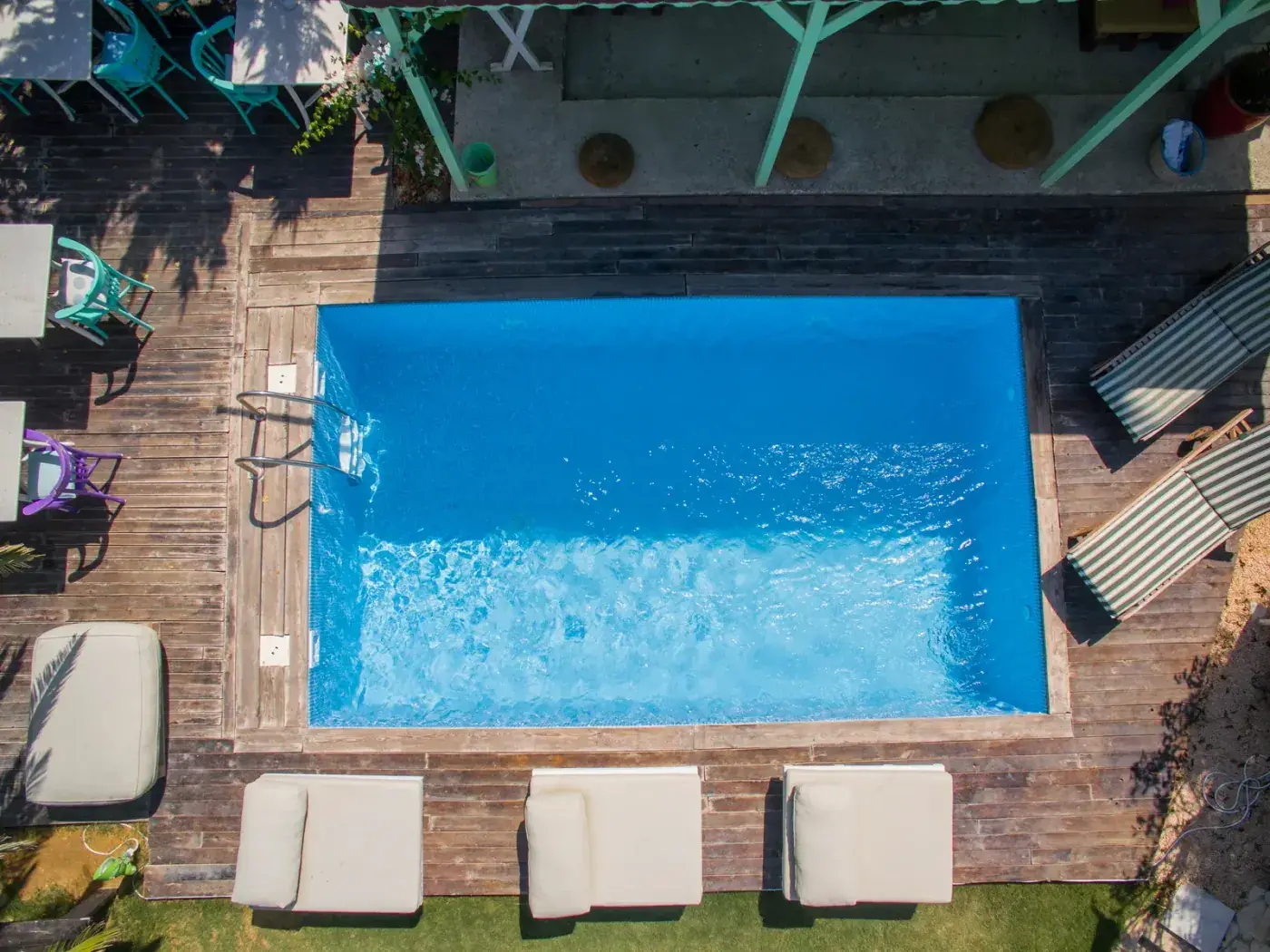
Pool models, construction conditions and care to help you plan your project.
In this guide 4
Project note: The base thickness, concrete class, reinforcement, excavation allowance, pipe diameter and quantities given in this guide are preliminary planning examples; they do not constitute a structural design that can be applied to every site. The design must be prepared by a qualified engineer after evaluating the geotechnical investigation, groundwater, loads and local regulations. A full pool can also be affected by external hydrostatic pressure; draining, drainage and electrical work require expert supervision. The thrust, tonnage and quantity figures in the text are examples based on clearly stated planning assumptions rather than on measured ground data.
One of the riskiest practices carried out on site after the pool frame has been erected is backfilling around the pool walls with the clayey, sticky and wet garden soil that came out of the excavation, simply to avoid the cost of hauling the spoil away. The clayey soils frequently encountered in Batumi and the Adjara region can display variable-volume behaviour: they swell when they meet water and shrink in dry periods, opening up cracks. Whether a given plot contains clayey soil, and what the swelling potential of that soil is, can only be determined by a geotechnical investigation. An uncontrolled backfill of this kind applies irregular, high lateral thrust to the pool panels and can bend them inwards; when it dries out it settles and can cause cracking in the coping and terrace finishes at the pool edge. For this reason, backfilling with clayey soil is not accepted in the Sermed Havuz installation specification; the backfill is required to be made with 10-20 mm screened crushed stone or lean dry mortar.
When a clayey soil with high swelling potential absorbs water it expands and can apply significant lateral thrust to the pool panels; when it dries it shrinks and settles, which can damage the surrounding sun terraces. For this reason the area around the pool frame should not be filled with excavated soil, but with 10-20 mm screened crushed stone or lean dry mortar, placed in stages of roughly 30 cm at a time, simultaneously with the filling of the pool with water.
As the inside of the pool fills with water, the outside must be filled in the same balanced way. Keeping the internal water pressure and the external backfill pressure close to one another is the basic principle for keeping the panels vertical.
01. The Swell-Shrink Mechanism of Clayey Soil and Its Lateral Thrust on the Panel Shell
Structural damage that can be seen when backfill is carried out with clayey soil of high swelling potential:
- Swelling Pressure of Wet Clay: Clay that absorbs rainwater expands; when the pool is drained or the water level is lowered, it can bend the panels inwards.
- Terrace Settlement: Clay that dries out in summer loses volume; the ceramic and deck finishes at the pool edge lose the support beneath them and can crack when stepped on.
- Choking of the Drainage: Clayey soil has low permeability; it can retain rainwater and create a water-saturated hollow behind the pool, and fine-grained material can clog the drainage pipes.
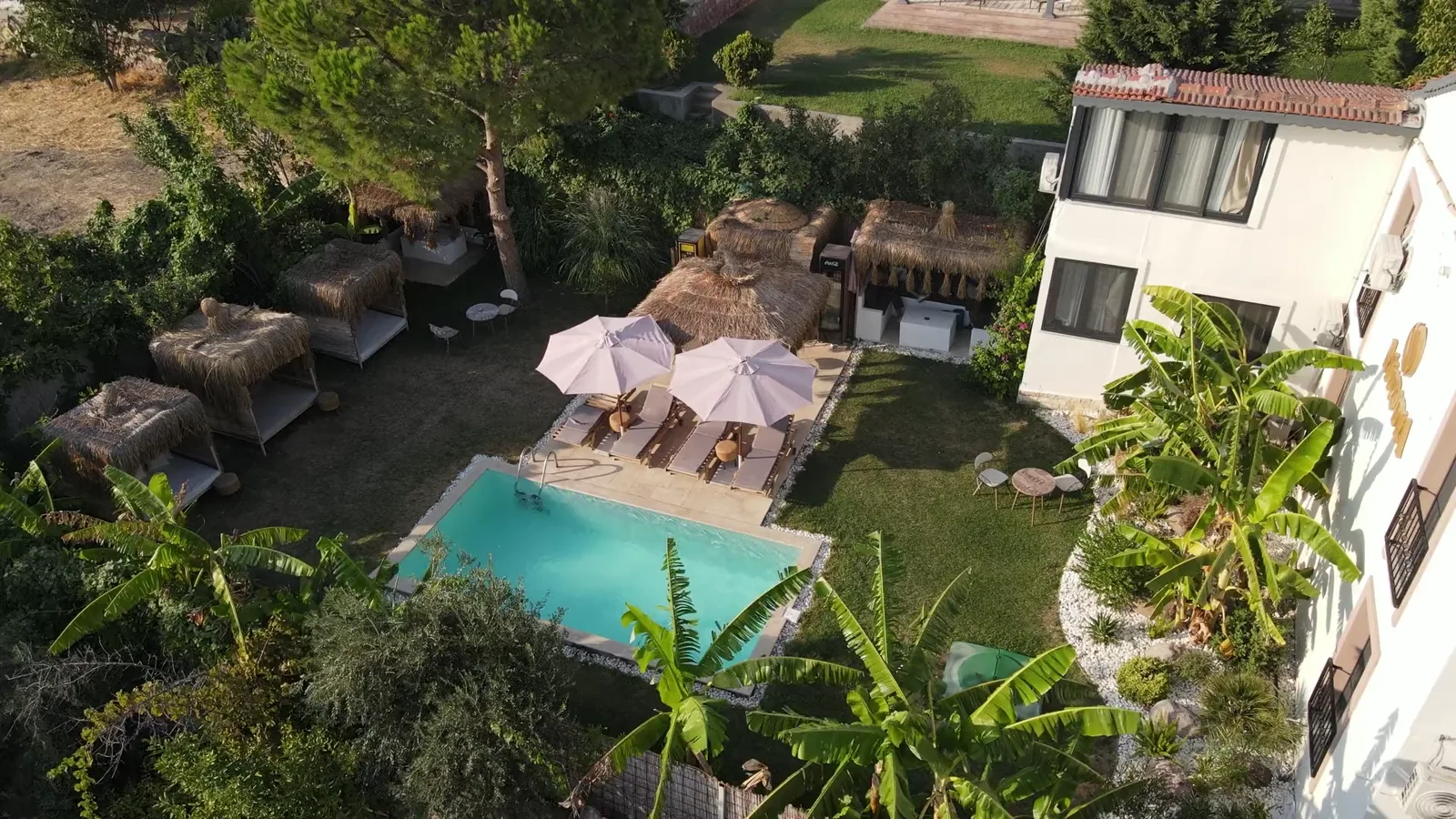 Fiplus ↗
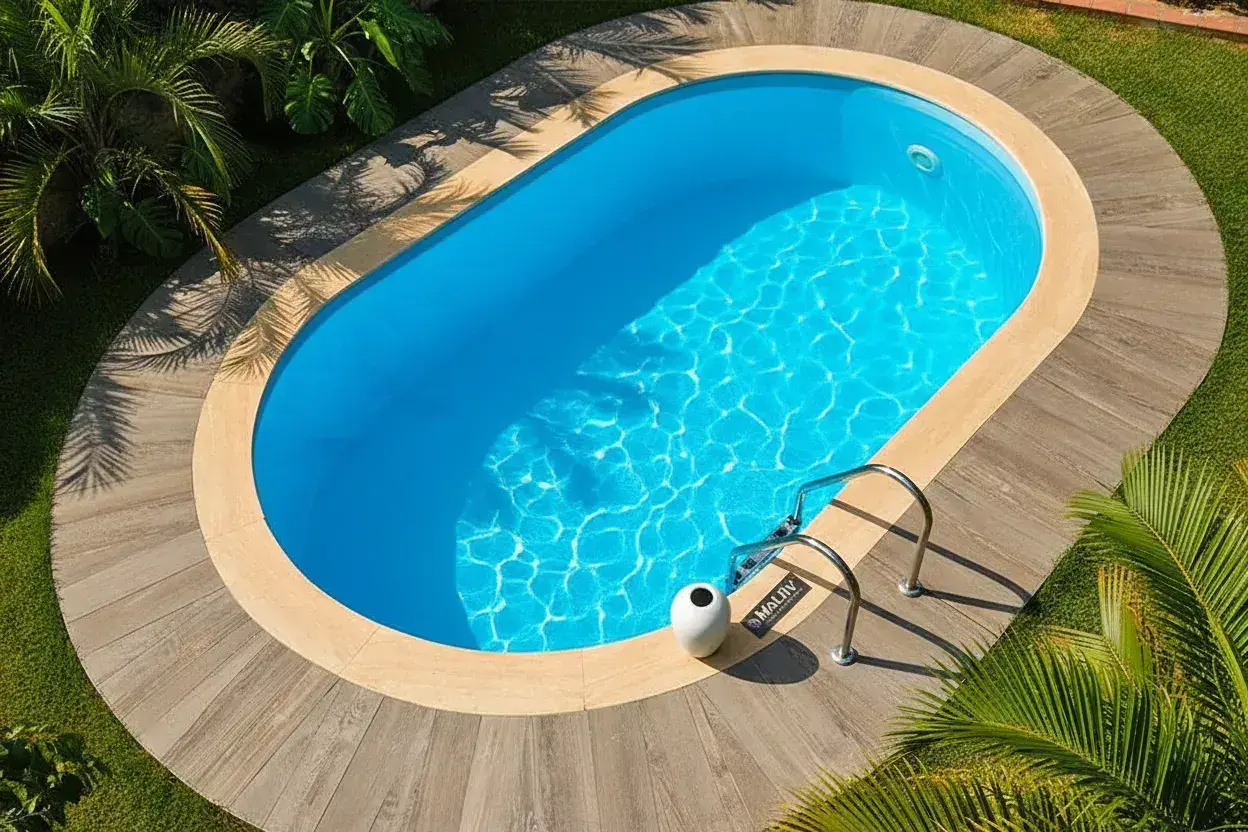 Maldiv ↗
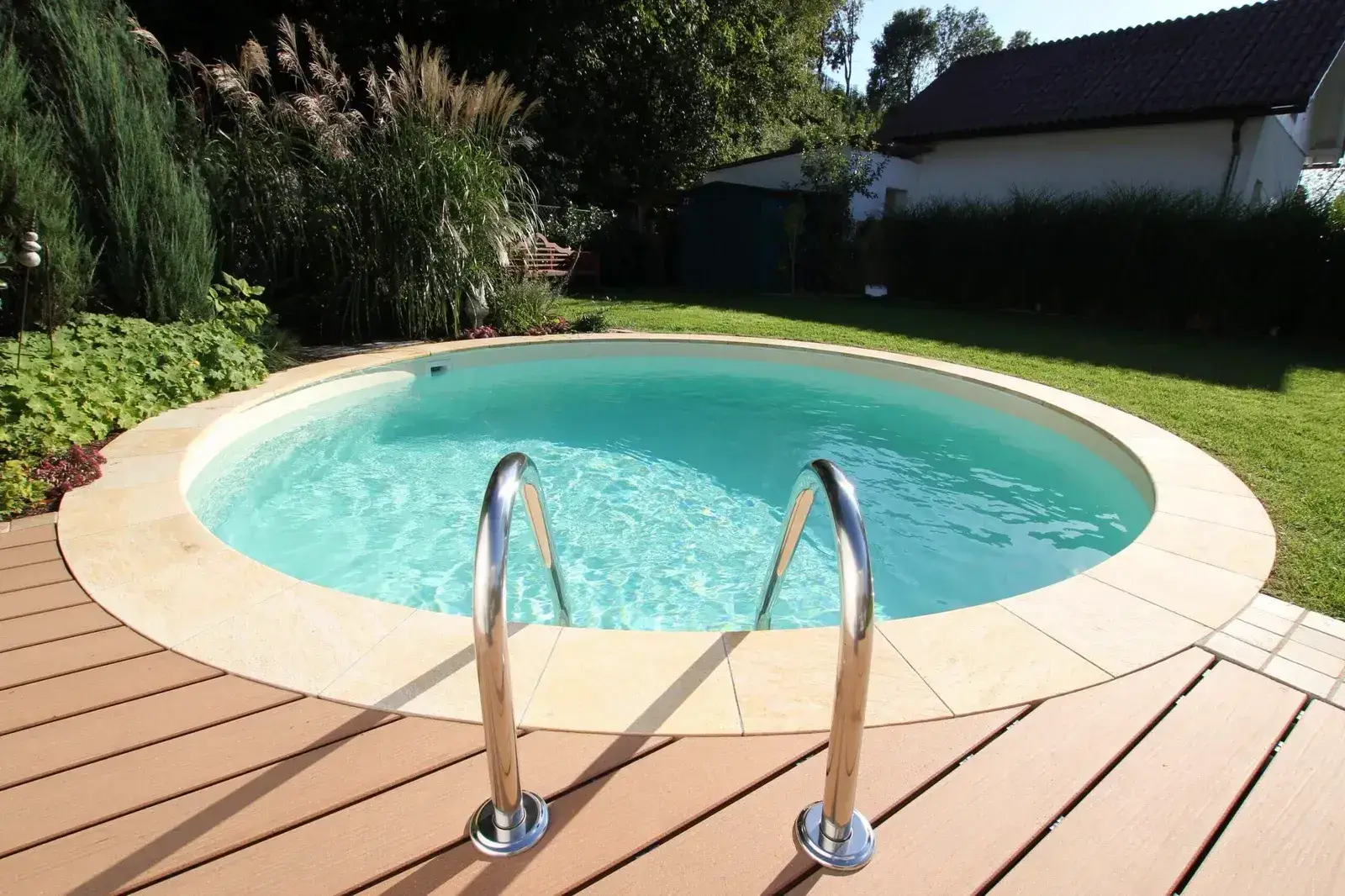 Bora ↗
02. The Sermed Backfill Standard: Simultaneous Water Filling and a Crushed Stone Drainage Shield
The backfill discipline applied during Sermed Havuz installation:
- Simultaneous Raising Rule: About 30 cm of water is pumped into the pool; then 30 cm of crushed stone is poured around the outside; the internal and external pressures are kept close to one another and the levels are raised stage by stage.
- 10-20 mm Washed Crushed Stone: When properly compacted, crushed stone backfill shows no appreciable settlement or swelling; it is intended to filter rainwater down to the drainflex pipe at the base and thereby reduce the lateral hydrostatic load.
- Lean Dry Mortar: On projects where heavy travertine or marble terraces are to be laid, dry mortar is used instead of crushed stone to form a more rigid protective shell; the mortar mix and thickness are determined by the project engineer.
03. Comparison Table of Backfill Materials: Clay vs. Crushed Stone vs. Dry Mortar
| Backfill Material | Drainage Permeability | Swelling / Settlement Risk | Pressure on the Panel Frame | Suitability on Site |
|---|---|---|---|---|
| Clayey Soil from the Excavation | Very poor (traps water) | High (can cause terrace finishes to settle) | Irregular and high lateral thrust | Not used as backfill |
| 10-20 mm Crushed Stone | High (drains water quickly) | Very low (no appreciable settlement when properly compacted) | More homogeneous and balanced distribution | General-purpose choice |
| Lean Dry Mortar | Medium | Very low (hardens and locks together) | Rigid protective shield | Suitable for heavy terraces |
Conclusion: Using the right material as backfill is intended to extend the life of your surrounding terrace. Although backfilling with clayey soil may look like a short-term saving, it creates a serious risk for both the terrace and the shell.
Frequently asked questions
How many cubic metres of crushed stone backfill are needed for a 4x8 m pool?
For a 4x8 m pool approximately 1.5 m deep, with a 1 metre working allowance left on all four sides, the surrounding backfill area is roughly (6x10) - (4x8) = 28 m²; assuming a backfill height of 1.5 m, this corresponds to approximately 40 m³ of material. If the working allowance is reduced to 50 cm, the same calculation gives approximately 20-24 m³. The exact quantity must be calculated in the project according to the excavation allowance and depth.
Can the pool be left empty while the backfill is placed?
No. If backfill is placed outside while the pool is empty, the lateral pressure of the fill can bend the panels inwards; the internal water and the external backfill must be raised simultaneously.
Can ceramic tiles be bonded directly onto crushed stone backfill?
No. A reinforced concrete surround slab must first be poured over the crushed stone backfill, and the ceramic or travertine bonded afterwards. The concrete thickness and reinforcement are designed according to the loading; a thickness of 10 cm is only a reference value for preliminary planning.
What should be done with the soil from the excavation?
Clayey soil that is unsuitable for backfill should be hauled off site; the humus-rich topsoil above it can be set aside for landscaping and lawn areas.