Pool models, construction conditions and care to help you plan your project.
In this guide 4
Project note: The base slab thickness, concrete class, reinforcement, excavation allowance, pipe diameter and quantities given in this guide are preliminary planning examples; they do not constitute a structural design that can be applied to any given site. The design must be prepared by a qualified engineer after evaluating the geotechnical investigation, groundwater, loads and local regulations. A full pool can also be affected by external hydrostatic pressure; if the water level outside is higher than the water level inside, liner floating can occur even in a full pool. Draining, drainage and electrical work require specialist supervision. Seismic resistance cannot be inferred from the shell material; it is assessed only through a project-specific structural calculation, and no product can guarantee performance against a particular earthquake magnitude.
Adjara and the Batumi region lie within the Caucasus tectonic belt, and designs there must take earthquake effects into account. For region-specific magnitude, acceleration and return period values, the official seismic hazard maps in force and the local regulations must be taken as the basis; this text does not provide a numerical magnitude estimate attributed to the region. During an earthquake, ground motion shakes the pool shell while the water mass inside it, due to inertia, applies dynamic sloshing pressure to the walls. As an example, the water mass in a pool of roughly 50 m³ is on the order of 50 tonnes; this is purely a volume-based calculation example and must be derived from each pool's own volume. In reinforced concrete shells with insufficient reinforcement, poorly detailed joints, or dimensions not matched to the geotechnical investigation, this dynamic load can increase the risk of cracking and leakage at the joints where the base meets the wall. On the other hand, correctly engineered reinforced concrete pools can also be built to resist earthquakes; it is not accurate to conclude generally that all reinforced concrete pools crack or inevitably leak. In Sermed Havuz's modular Fiplus system, the shell is made up of 20 mm F-Stone fibre cement panels, and galvanized steel external cross braces act as a separate load-bearing component; internal watertightness is provided by a 0.8 mm homogeneous or 1.5 mm reinforced liner membrane. A flexible membrane is a covering that can accommodate limited movement; however, watertightness cannot be promised under all conditions, and the system's seismic performance must again be verified by a project-specific calculation.
The dynamic sloshing pressure that water applies to the walls during earthquake shaking can increase the risk of cracking and leakage at joint regions in inadequately detailed reinforced concrete pools. The Fiplus shell, made up of bolted modular F-Stone panels, together with galvanized steel external cross braces, is configured so that loads are distributed among more than one component; the liner membrane inside it (0.8 mm homogeneous or 1.5 mm reinforced) can accommodate limited movement. The outcome of this behaviour in a real earthquake depends on ground conditions and the structural design.
What matters in an earthquake is not the brand of the material but whether the loads are calculated correctly and the details resolved correctly. A system able to flex may offer an advantage, but that advantage only becomes meaningful with project-specific engineering verification.
01. Seismic Water Sloshing Loads and the Cracking Mechanism in Reinforced Concrete
Types of structural damage that may be seen after an earthquake in reinforced concrete pools that are inadequately designed or detailed:
- Hydrodynamic water thrust (Housner approach): The water mass moving with the seismic acceleration applies impulsive pressure to the walls; cracking can occur in walls with insufficient shear and bending capacity. The magnitude of the load depends on the pool volume, geometry and design acceleration.
- Cold joint separation: Where the base and wall concrete are poured in two stages, the joint can separate and create a leakage path if the waterstop and reinforcement continuity are not resolved correctly.
- Ground behaviour risk: Leaking water may contribute to a loss of bearing capacity or to settlement in the ground. Liquefaction risk, however, is determined only through a geotechnical investigation, by evaluating the grain size distribution of the soil and the groundwater conditions; such a risk cannot be assumed for every clayey soil.
 Fiplus ↗
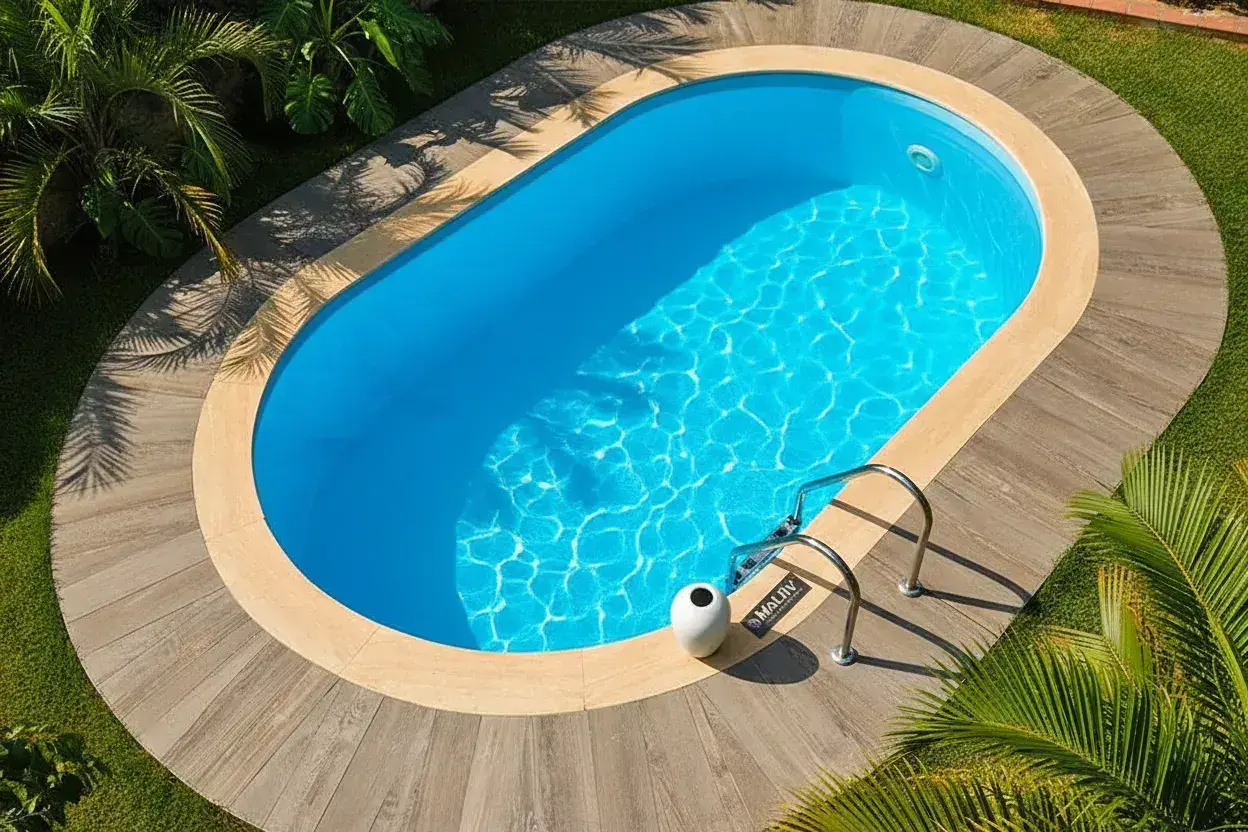 Maldiv ↗
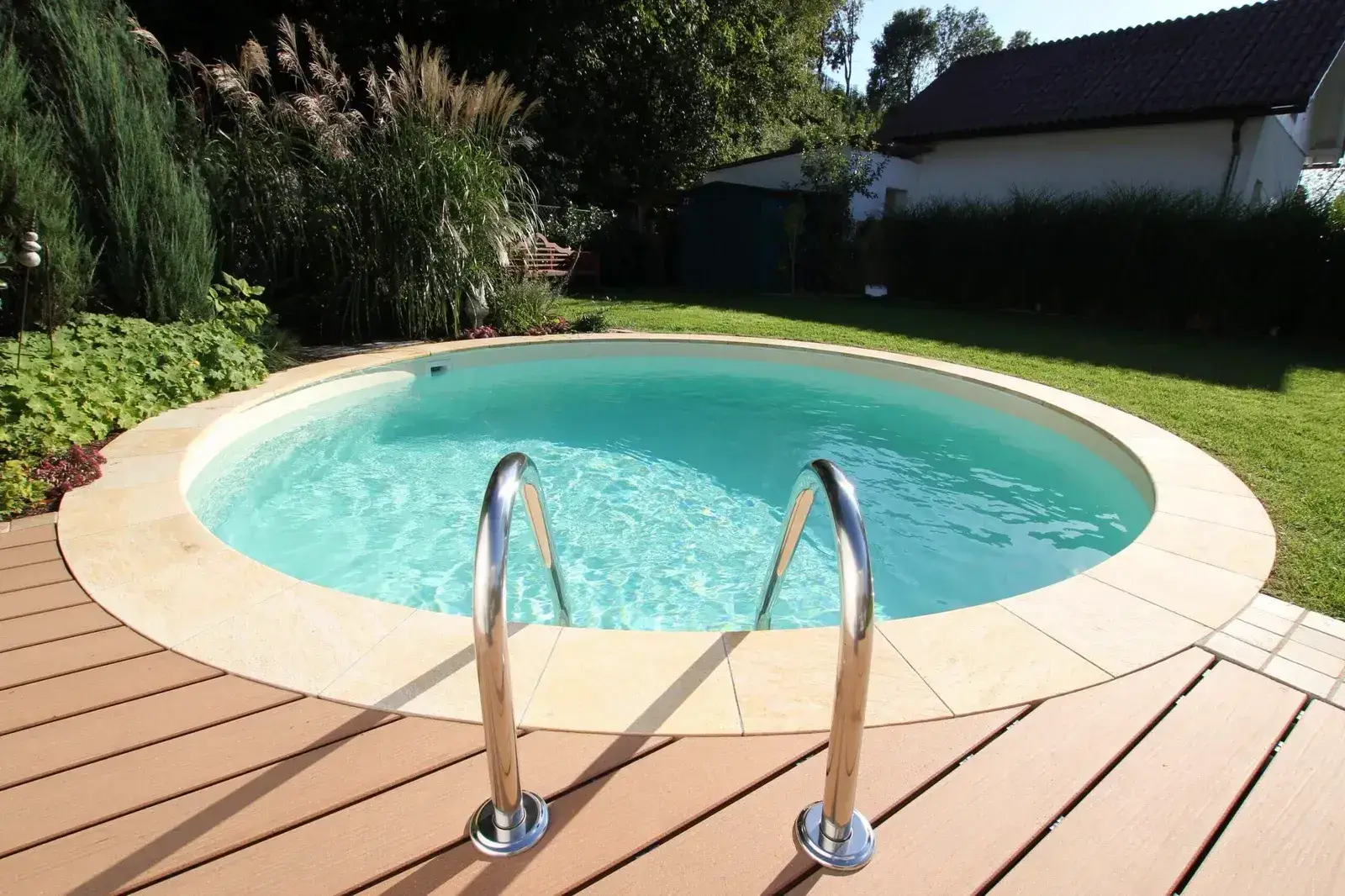 Bora ↗
02. Sermed Havuz Panel Architecture: F-Stone Shell, Steel Braces and Flexible Membrane
The system components used by Sermed Havuz and the principles observed with respect to earthquakes:
- Modular panels and load distribution: 20 mm F-Stone fibre cement panels are joined with bolted connections, and galvanized steel external cross braces are configured as a separate element to resist lateral loads. The aim is to distribute the load across the connections rather than through a single rigid section.
- Flexible liner membrane: Watertightness is provided by a 0.8 mm homogeneous or 1.5 mm reinforced liner. The membrane can accommodate limited movement and micro cracks; however, it cannot be guaranteed to remain undamaged under large structural displacements.
- Raft slab reference detail: The manufacturer's reference detail specifies a raft slab of 20 cm C30 concrete with Q131 two-way mesh reinforcement. This is a starting reference; the final thickness, concrete class and reinforcement are determined according to the geotechnical investigation and the structural calculation, and it is not a recipe valid for every soil.
03. Response Table: Reinforced Concrete vs. Fiplus Panel under Seismic Shaking
| Structural characteristic | Conventional reinforced concrete pool | Sermed Fiplus panel pool |
|---|---|---|
| Material structure | Monolithic, rigid section; behaviour depends on reinforcement and detailing | 20 mm F-Stone fibre cement panels and galvanized steel external cross braces |
| Resistance to water sloshing | Risk of cracking increases if joint and connection detailing is weak | Configured so that lateral loads are distributed through the steel braces and bolted connections; capacity is calculated per project |
| Flexibility of the internal lining | Rigid finish; ceramic tiling or render may crack under large movements | 0.8 mm homogeneous or 1.5 mm reinforced flexible liner membrane |
| Repair after an earthquake | Injection, local repair or extensive intervention depending on the degree of damage | Liner repair, panel or connection replacement depending on the type of damage; method and cost depend on the engineer's diagnosis |
Conclusion: In the Batumi region, where earthquake effects must be taken into account, both reinforced concrete and panel pools are considered safe only when verified through a geotechnical investigation and a structural calculation. The modular and flexible components of panel systems may offer an advantage in terms of ease of repair; usability after an earthquake, however, is determined by a site inspection.
Frequently asked questions
What should be checked first in a pool after an earthquake?
The skimmer throats, light niches and the areas around nozzle flanges should be checked, and the pipe unions in the plant room should be inspected for dripping. If an unexpected drop in the water level, a new crack in the shell or settlement in the ground is observed, a qualified engineer should inspect the pool before it is used.
Do buried pipes break during ground shaking?
Pipe damage depends on the magnitude of the ground movement, the quality of the backfill and the connection details. In Sermed Havuz installations, the risk is reduced by using pipes of a suitable pressure class (for example PN10/PN16) with movement allowance at the shell penetrations, together with flexible sleeve/expansion joint solutions; these measures do not guarantee that no breakage will occur.
Can a cracked reinforced concrete pool be made earthquake resistant with a liner?
A liner is a surface solution that provides watertightness; on its own it is not structural strengthening. The cause of the existing cracks (settlement, insufficient reinforcement, water pressure) must be diagnosed by an engineer, and a 1.5 mm reinforced liner can be applied after the necessary structural repair has been carried out. Complete demolition is not required in every case; the method is determined by the diagnosis.
Is there an earthquake test for F-Stone panels?
We do not hold a published seismic product test certificate issued by third-party laboratories, and we do not refer to any such document. The seismic behaviour of the panels in a pool is assessed through a project-specific structural calculation of the system as a whole rather than through component test reports. Manufacturer technical data for the panels and fasteners used can be shared on request.