Pool models, construction conditions and care to help you plan your project.
In this guide 4
Project note: The base thickness, concrete class, reinforcement, excavation allowance, pipe diameter and quantities given in this guide are preliminary planning examples; they are not a structural design that can be applied to every site. The design must be prepared by a qualified engineer after evaluating the geotechnical investigation, groundwater, loads and local regulations. Even a full pool can be affected by external hydrostatic pressure; draining, drainage and electrical work require expert supervision.
Adjara and the Batumi coastline have a humid subtropical character and a high-rainfall climate; current local meteorological data must be taken as the basis for the design rainfall. Trying to manage a pool site in this climate as if it were under classic Mediterranean or Aegean conditions ends with the excavation pit turning into a lake and garden soil washing into the pool shell. During pool construction, leaving a sufficient working allowance around the excavation (commonly in the order of 1 metre in practice), installing graded perimeter drainage and connecting the skimmer overflow discharge lines at an adequate diameter are items that must not be skipped. The size of the allowance and the slope angle are determined by a qualified engineer according to the soil class.
Building a pool in Batumi, where heavy downpours occur, requires calculating how water moves not only inside the pool but also around its perimeter. The rainfall quantities used in this article are a hypothetical calculation example; the value to be used in the design must be taken from local meteorological records. While sites where no water management is carried out during the excavation stage sit in mud for days, prefabricated panel systems can be assembled noticeably faster on a prepared site; because the exact duration depends on the weather, the ground, the utilities and the scope of the landscaping, no fixed commitment in days can be given.
01. The Risk of Collapse and Mudding of the Excavation Site in Heavy Batumi Rainfall
Across Adjara the soil is suited to citrus and tea cultivation, and its upper layer consists of clayey and sandy loam rich in organic matter. As soon as this soil type becomes saturated it loses its bearing capacity dramatically:
- Sliding of Excavation Slopes: Carrying out unsupported vertical (90 degree) excavation in saturated clayey soils is a serious occupational safety risk. Clayey slopes that become wet under excessive rainfall can crack and slide into the excavation pit. For this reason a sufficient working allowance must be left in the excavation, the slope angle must be benched according to the soil class, or shoring must be installed if deemed necessary; the allowance and slope values are determined by a qualified engineer on the basis of the geotechnical investigation.
- Muddying of the Base: If the base is left exposed after the excavation is completed, incoming rain turns the base soil into slurry. If concrete is poured directly onto this slurry, the bearing capacity of the base soil remains unreliable, mud mixing into the concrete can upset the water/cement ratio, and the base becomes prone to differential settlement.
- Backfill Settlement: Backfilling the perimeter with the clayey mud taken out of the excavation once the pool has been installed is the greatest misconception. Clay soil shrinks when it dries and swells when it becomes wet; this cycle can soon cause settlement and cracking in the walkways, tiles and deck coverings at the pool edge. How long this takes depends on the soil type, the compaction of the backfill and the rainfall regime.
- Disruption of the Pool Water's Mineral Balance: In pools where no perimeter drainage has been installed, muddy, fertilizer-laden rainwater overflowing from the garden surface passes the skimmer level and flows into the pool; this can rapidly upset the pH, alkalinity and disinfectant balance of the pool water and set the stage for cloudiness and algae growth.
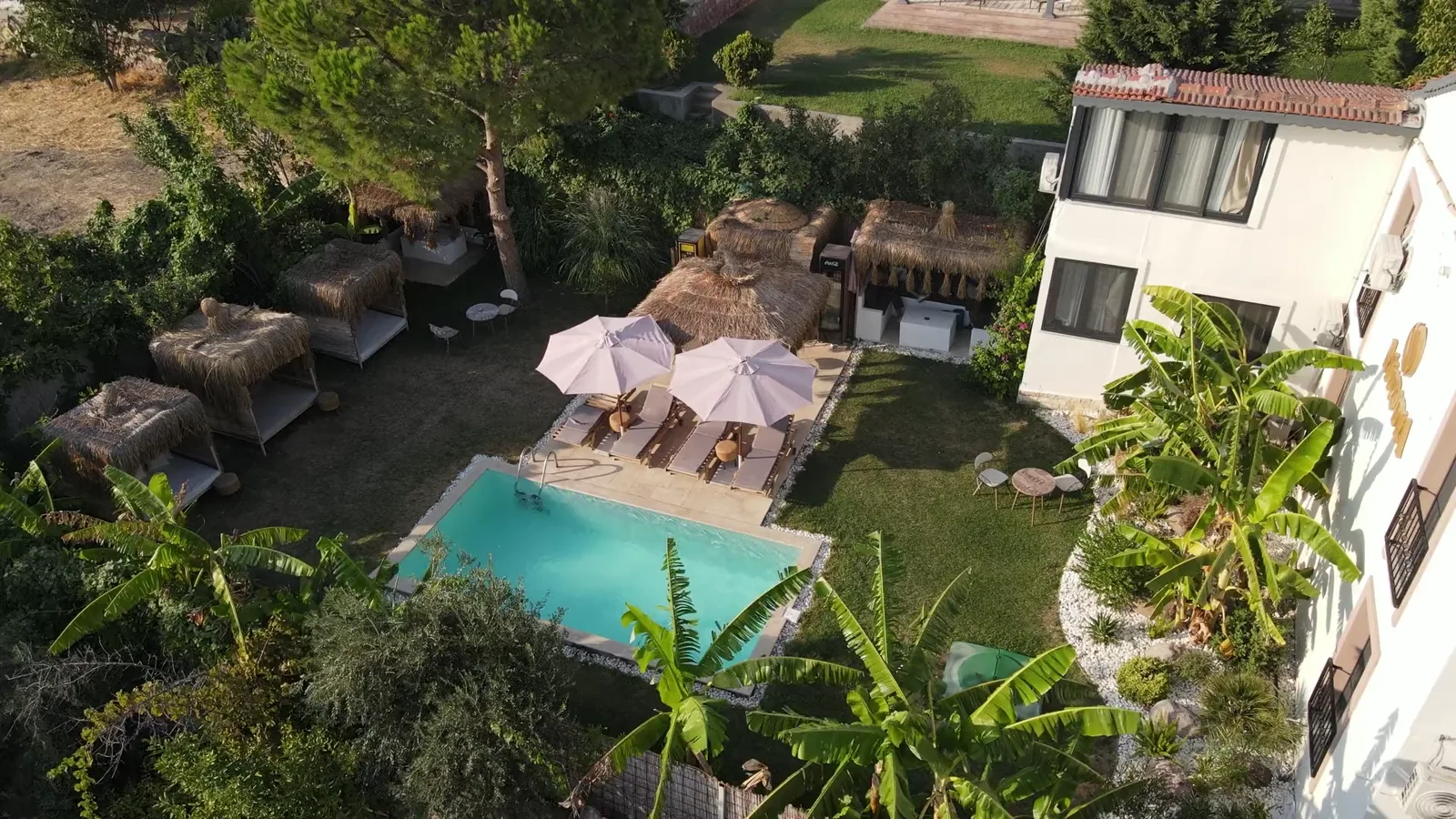 Fiplus ↗
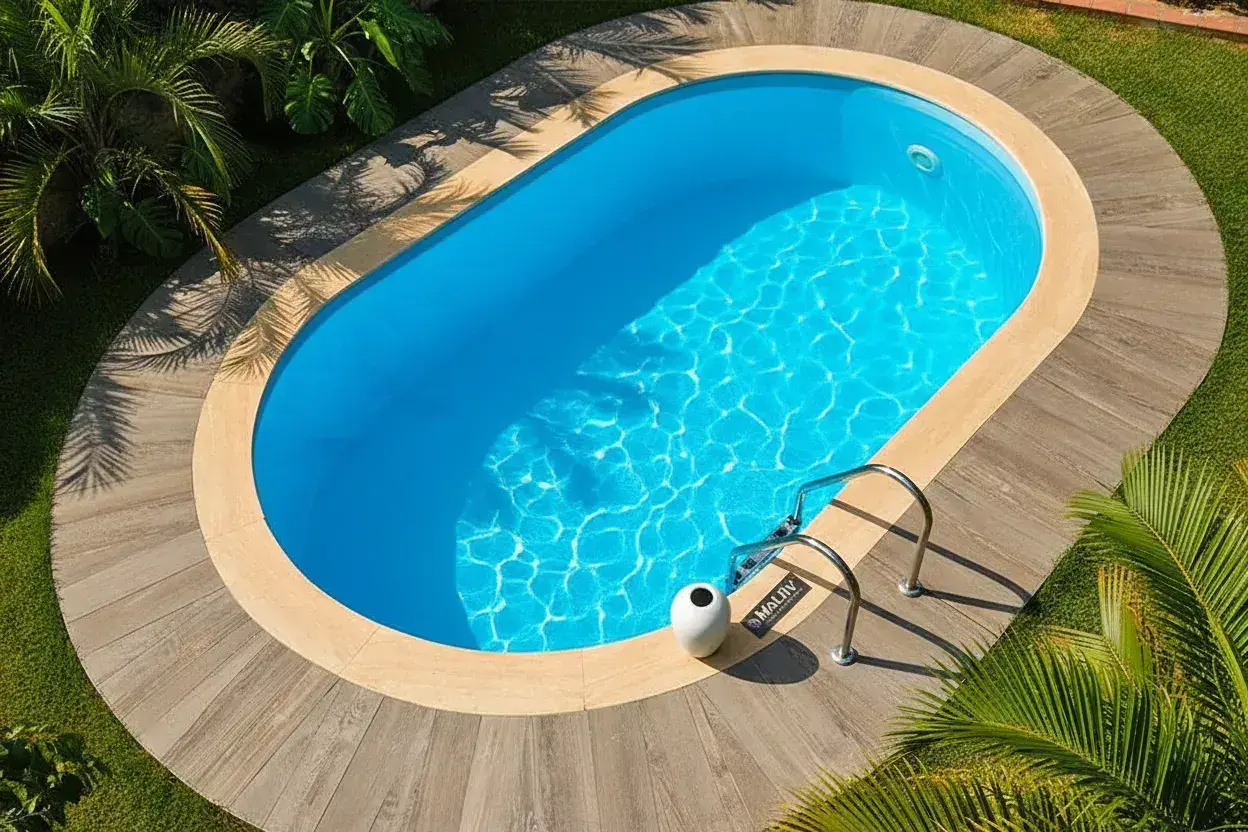 Maldiv ↗
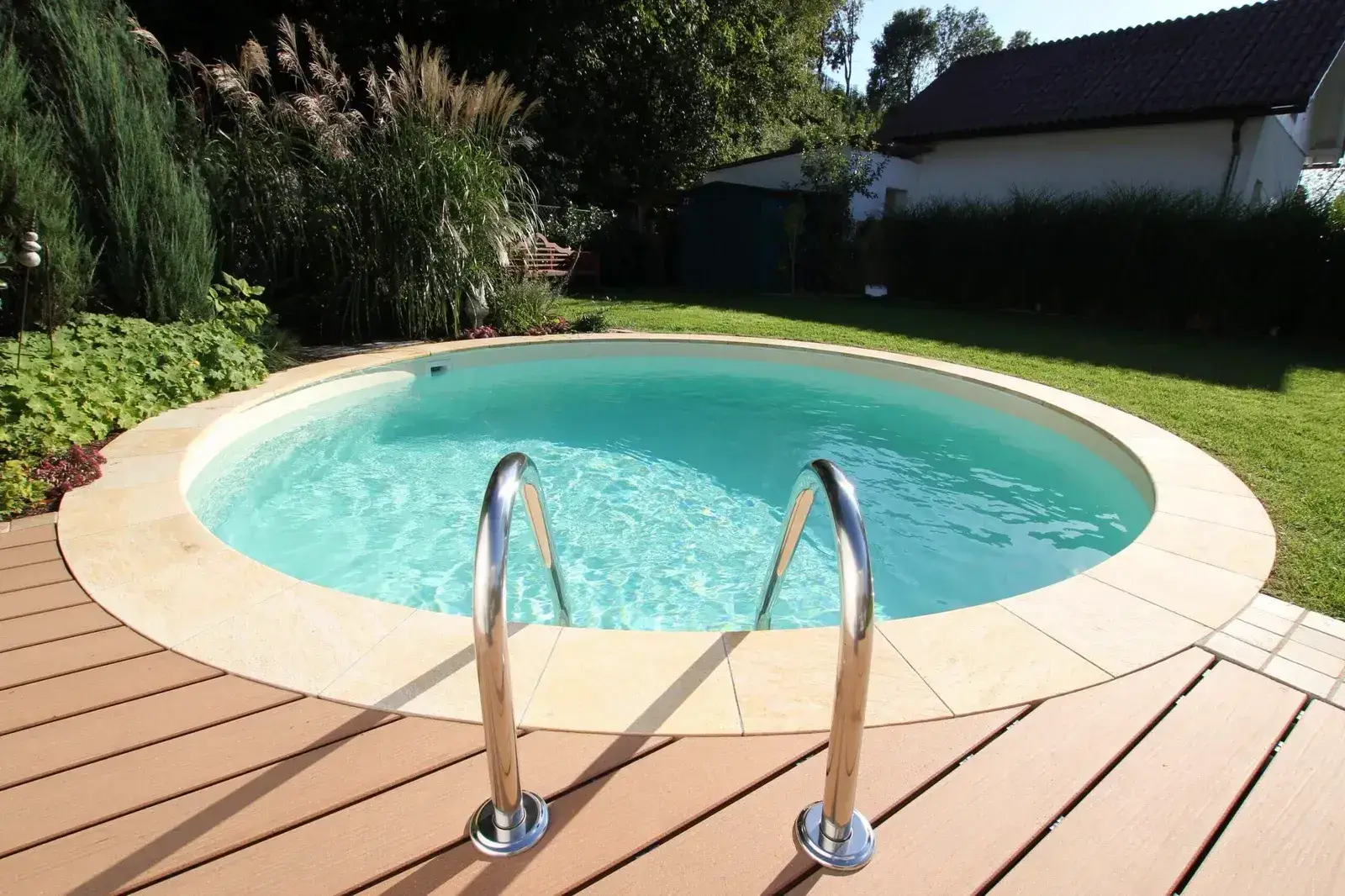 Bora ↗
02. Graded Drainage Standard, Geotextile Filtration and the Skimmer Overflow Line
The rainfall management approach that Sermed Havuz recommends for high-rainfall regions consists of four main layers:
- Base Blinding and Lean Concrete Isolation: The 15–20 cm crushed stone blinding laid on the excavation base allows the water in the ground to move freely. The polyethylene membrane laid over it forms a moisture barrier, and the reinforced base concrete is poured on top of that. The values of Q131 mesh with 20 cm of C30 are the manufacturer's reference detail; they are not a recipe valid for every site and must be verified with a geotechnical investigation and structural calculation.
- Graded Perimeter Drainage (French Drain): The backfill placed between the pool frame and the soil must definitely not be made with clayey soil, but with 10–20 mm screened gravel or oil-free coarse sand. The Ø100 perforated PVC drenflex pipe laid at the lowest level collects the water without clogging thanks to its geotextile fabric sleeve and conveys it to the main stormwater line.
- Skimmer Overflow Discharge: As a hypothetical example, 100 mm (100 litres/m²) of rainfall falling on the pool surface raises the pool water level by roughly 10 cm; the rainfall value to be used in the design must be taken from local meteorological records. The Ø50 mm PVC pipe connected to the factory overflow outlet on the skimmer body transfers this excess water directly to the garden drainage and helps prevent water from spilling over the coping stones into the garden.
- Shorter Installation Time (Reducing the Open Site Period): In a reinforced concrete pool, formwork, reinforcement, concrete pouring and curing can take weeks in a rainy climate, and work stops with every rainfall. With a panel system, once the base concrete is ready, shell assembly can usually be completed within a few days. The advantage this creates is a shorter period during which the open excavation is exposed to bad weather; the extent of this reduction varies with the project, the weather conditions and the scope of work, and no fixed percentage can be committed to.
03. Excavation and Drainage Quantity Table for the Adjara Rainfall Regime
| Site Component | Conventional Inadequate Practice | Sermed Havuz Rain-Resistant Site Standard | Engineering Function |
|---|---|---|---|
| Working Allowance | Narrow excavation at pool dimensions (under 50 cm) | Roughly 1 metre of working allowance on all four sides (according to the ground, with engineer approval) | Reduces the risk of slope sliding, allows drainage to be installed |
| Backfill Material | Clayey garden soil taken out of the excavation | 10-20 mm screened river gravel or crushed stone | Lets water drain quickly to the base, exerts no swelling pressure on the side panels |
| Drainage Piping | No drainage pipe is installed | Ø100 mm perforated drenflex pipe with geotextile fabric | Transfers accumulated rainwater immediately to the discharge well |
| Overflow Safety | The skimmer overflow outlet is blanked off or left unconnected | Ø50 mm PVC overflow pipe connected to the main drain (diameter verified according to the design rainfall and pool area) | Reduces the risk of pool water spilling from the coping into the garden and landscaping |
| Time Spent as an Open Pit | Can take weeks because of concrete curing and coating waiting times | Panel shell and liner installation typically a few days (if the site is ready and the weather is suitable) | Helps shorten the time spent with an open excavation in the rain |
Conclusion: When building a pool in Batumi and Adjara, perimeter drainage is the last item to economize on. In a pool whose drainage has been left incomplete, the surrounding landscaping and ground stability can be damaged during heavy rainfall.
Frequently asked questions
What infrastructure should be installed to drain the rainwater that overflows around the pool shell in Batumi's extreme rainfall regime?
A perforated drenflex pipe line wrapped in geotextile fabric and starting at the excavation base level should be laid around the pool shell, covered with gravel, and this line should be connected to the stormwater drain on the sloping side of the garden or to an inspection well with an automatic submersible pump.
Why does the skimmer overflow discharge clog and how is this prevented?
It can clog when the skimmer overflow pipe diameter is chosen too small (such as Ø32 mm) or when no leaf trap is fitted. The recommended practice is to use rigid PVC pipe of at least Ø50 mm and to connect the line to a closed drainage system; the final diameter must be calculated according to the pool surface area and the design rainfall.
What should be done if heavy rain starts immediately after the excavation has been dug?
Water must not be allowed to pond on the excavation base; a temporary collection sump should be opened in the deepest corner of the pit and the water discharged continuously with a portable pump; the C30 concrete pour should be completed before the base turns to mud.
How does rainwater affect the pool's chemical balance?
Rainwater can generally be slightly acidic and carries atmospheric dust and an organic load into the pool. After heavy rain the pH and disinfectant level can change. For this reason the water must always be measured with a test kit after a storm, the pH brought to the generally accepted range of 7.2–7.6, and disinfectant topped up if the measurement requires it. The quantity of chemical to be used is determined by the measurement result and the dose on the product label; chemicals are never mixed with one another, each is added separately and diluted according to its instructions.