Pool models, construction conditions and care to help you plan your project.
In this guide 4
Application note: Chemical doses, pH/chlorine targets, operating times and maintenance intervals are determined according to the product label, measured water values, the usage class and local requirements. Numerical examples are not, on their own, application instructions. Chemicals must never be mixed with one another; electrical work, pressurized equipment and pool draining operations must be carried out under expert supervision and in accordance with local standards.
The service life of a pool with a liner covering depends not only on the quality of the material but also on the chemical balance of the water it contains. One of the shortcomings frequently seen in pool operation is treating water analysis as nothing more than a simple chlorine measurement and disregarding the Langelier Saturation Index (LSI). Acidic pH values that persistently sit below 7.0 and free chlorine levels raised without control can, over time, draw the plasticizers out of the liner membrane and so contribute to the material losing its flexibility, becoming brittle and developing early wrinkles at the waterline. At Sermed Havuz we regard the discipline of keeping the water's LSI balance within the range of -0.3 to +0.3 as the fundamental maintenance approach that extends liner life.
Pool chemistry is not a matter of guesswork but a question of water balance based on measurement. While unbalanced water serves the purpose of disinfection, it can also slowly wear away the pool covering.
01. The Chemical Effect of Acidic pH and Excess Chlorine on Polymer Molecules
The physical deterioration that can be seen in a liner covering in unbalanced pool water is as follows:
- Plasticizer Leaching (Dissolving of the Oils): When the pH value of the water falls below 7.0 it takes on an acidic character. Acidic water can accelerate the migration of the plasticizers that provide flexibility between the PVC chains. The liner hardens, becomes brittle and loses part of its capacity for elastic extension.
- Undulation and Wrinkling on the Floor: Prolonged unbalanced chemical conditions can cause the membrane to absorb water unevenly and to swell locally, leading to permanent wrinkles on the floor.
- Bleaching by High Chlorine: When free chlorine is held above 4 to 5 ppm for a long period, the pigments of the liner can be affected; the bright blue colour may fade and become dull.
 Fiplus ↗
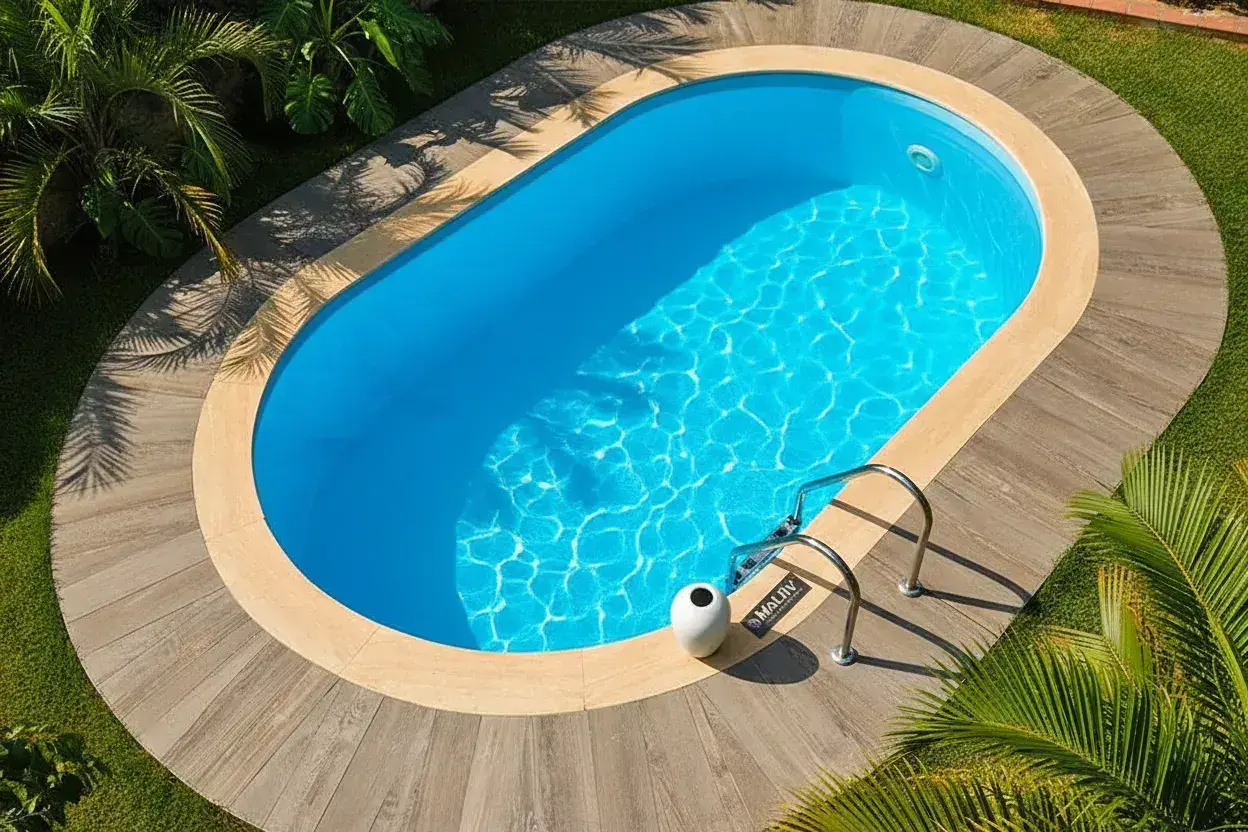 Maldiv ↗
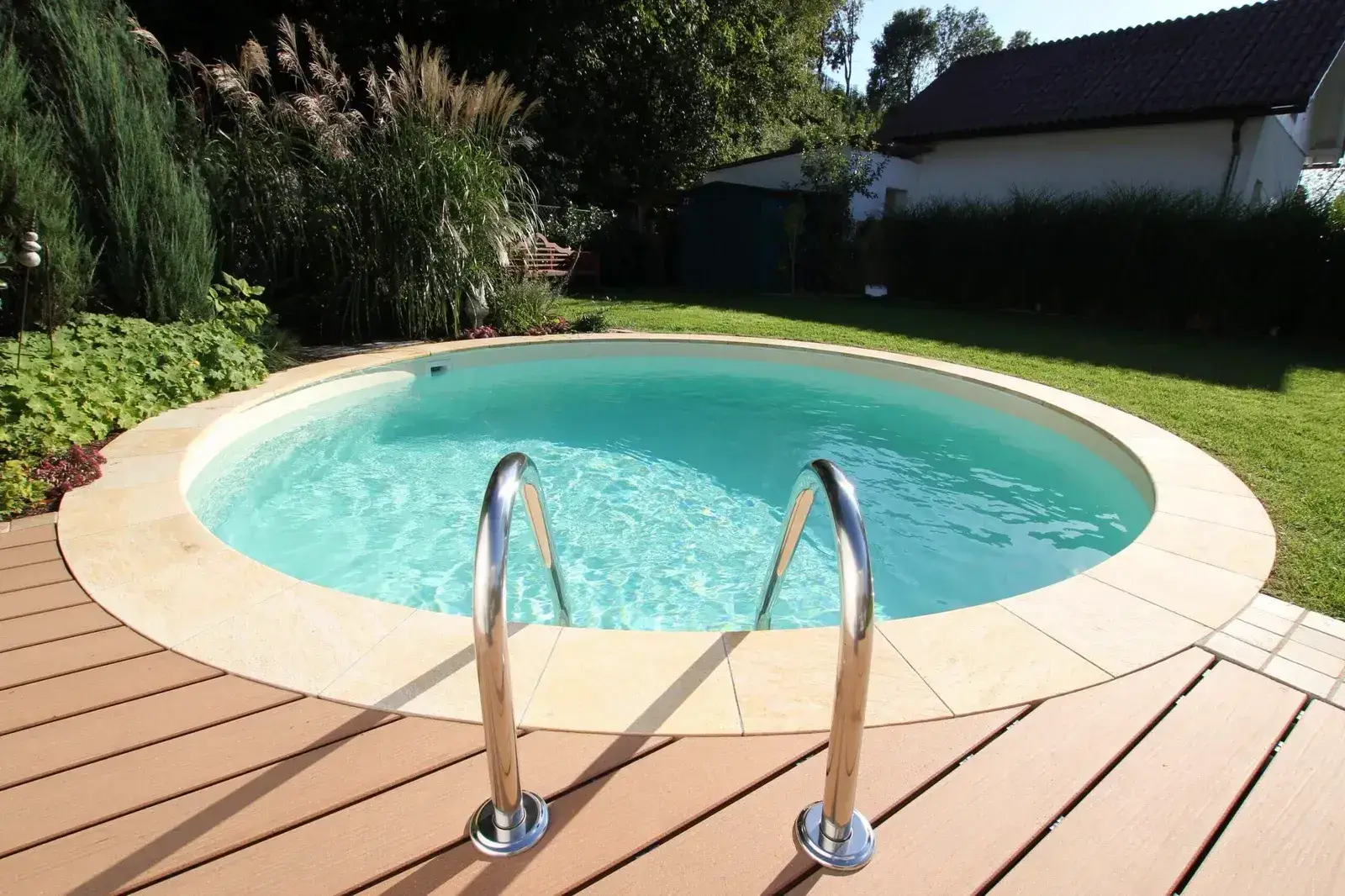 Bora ↗
02. The LSI (Langelier Saturation Index) Formula and Ideal Pool Water Parameters
LSI balance is the mathematical combination of 5 basic water parameters. The ranges below are common operating references; the final targets are determined according to the product label and local requirements:
- pH Value: It is recommended to keep this in the range of 7.2 to 7.6.
- Free Chlorine: The aim is to hold this steady in the range of 1.0 to 2.0 ppm.
- Total Alkalinity (TA): The range of 80 to 120 ppm (pH buffer).
- Calcium Hardness (CH): The range of 150 to 250 ppm.
- Water Temperature and the LSI Formula:
LSI = pH + TF (Temperature Factor) + CF (Calcium Factor) + AF (Alkalinity Factor) - 12.1. When the LSI value lies between -0.3 and +0.3, the water is neither markedly corrosive nor scale forming in character; water held within this band is expected to help the liner retain its flexibility for many years.
03. Table of Water Chemistry Values and Liner Material Response
| Parameter | Ideal Value Range | Incorrect Level | Effect on the Liner |
|---|---|---|---|
| pH Level | 7.2 – 7.6 | < 7.0 (Acidic) | Accelerates plasticizer migration; the liner hardens and may crack |
| Free Chlorine | 1.0 – 2.0 ppm | > 4.0 ppm (Excessive) | May accelerate fading of the colour |
| LSI Index | -0.3 to +0.3 | < -0.3 (Corrosive) | Corrosion on metal parts, risk of deterioration in the membrane |
| Total Alkalinity | 80 – 120 ppm | < 60 ppm | pH fluctuations increase, the water balance is disturbed |
| Cyanuric Acid | 30 – 50 ppm | > 80 ppm (Chlorine lock) | The effectiveness of the chlorine falls, and unnecessary chemical consumption occurs |
Conclusion: The greatest friend of a liner pool is correct water balance. Regular LSI checks and the pH 7.2 to 7.6 band help the liner retain its appearance and flexibility over a long period.
Frequently asked questions
Can unbalanced pool chemicals make the liner covering brittle and crack it early, and how is LSI balance maintained?
Prolonged imbalance increases this risk; low pH (acidic water) can accelerate the migration of the plasticizers within the liner, hardening the membrane and making it brittle. LSI balance is achieved by measuring pH (7.2-7.6), alkalinity (80-120 ppm) and calcium hardness regularly with a test kit and keeping them within the range of -0.3 to +0.3.
What is chlorine lock and how does it damage the liner?
When the cyanuric acid (stabilizer) level becomes excessively high (the commonly cited reference threshold is above 80 ppm), the disinfection effectiveness of the chlorine falls noticeably; the user then adds more chlorine in order to clear the water, and the continuously high chlorine level can accelerate wear of the liner. The approach followed in practice is to refresh part of the water with fresh water so as to lower the stabilizer level; the necessary proportion is determined according to the measurement result.
Is it necessary to use an automatic dosing system?
It is not compulsory; however, particularly in villa rentals or for users with limited time, an automatic pH reducer and chlorine dosing pump aim to keep the water chemistry more stable and so to reduce human error and liner wear. The system still requires regular calibration and manual verification measurement.
Are chemicals needed in a liner pool in winter?
Generally yes; a winterizing product applied at the start of winter together with shock chlorination can help reduce algae growth through the winter and makes it easier to open the pool in a cleaner state in spring. The choice of product and the dose are determined according to the label instructions and the measured water values; products are not mixed with one another.