Pool models, construction conditions and care to help you plan your project.
In this guide 4
Project note: The foundation thickness, concrete class, reinforcement, excavation allowance, pipe diameter and quantities given in this guide are preliminary planning examples; they do not constitute a structural design that can be applied to every site. The 20 cm C30 and Q131 values mentioned in the text are given as a manufacturer reference detail; they are not a universal recipe valid for every soil. The design must be prepared by a qualified engineer after evaluating the geotechnical investigation, groundwater, loads and local rules. A full pool can also be affected by external hydrostatic pressure; when the external water load exceeds the internal water load, the liner may lift. Draining, drainage and electrical works require expert supervision.
One of the claims property owners often hear while collecting prefabricated pool quotations is: "Our pool needs no excavation and no concrete; we simply spread and compact sand on the base." This approach has to be assessed technically. By way of an example calculation, a pool measuring 4×8 metres with an average water depth of 1.5 m holds roughly 48 m³ of water, which means approximately 48 tonnes of water weight (the shell, the lining and user loads are accounted for separately). On damp, alluvial or clayey ground, failing to distribute this load through an appropriately sized foundation slab can lead to problems such as differential settlement, the liner being strained by hard particles on the base, and loss of level. In Sermed Pools applications, 20 cm of C30 ready mixed concrete with Q131 steel mesh reinforcement is used as the reference base detail; the final thickness and reinforcement are determined according to the site soil and the structural assessment.
A pool is like the foundation of a building; a frame that does not rest on a suitable ground platform cannot be expected to carry safely the hydrostatic pressure of the many tonnes of water it contains.
01. Problems That Can Appear in Installations Without Concrete or With Weak Blinding Concrete
The typical failures that may be encountered where savings are made on the base concrete are as follows:
- Differential Settlement: Clayey soils can soften as they take on water. One corner of a pool installed on compacted sand or on thin unreinforced blinding concrete may settle a few centimetres more than another; the water line then looks crooked against the coping and the skimmer may draw air.
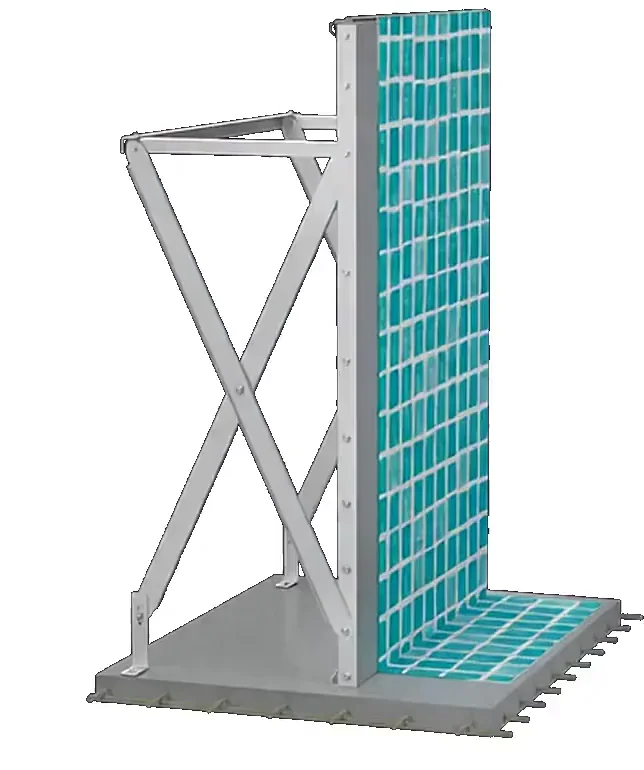
- Sinking of the Props: The side support props that carry Fiplus and Maldiv frames transmit high point pressure to the ground when the pool is full. Because the base area of a prop is small, if the resulting stress is not distributed by a wide slab, the props may sink into the soil and the walls may splay outwards. The point pressure value must be calculated from the prop base area and the load; it would not be correct to state a fixed figure here.
- Footprint Dips in the Liner Base: On sand or weak screed bases, the heel impacts of swimmers can crush the surface; dips and undulations may form on the base.
- Groundwater Straining the Base: When the water table rises, weak unreinforced mortars can crack under the hydrostatic pressure coming from below. For this reason, drainage and, where needed, dewatering solutions are designed.
 Fiplus ↗
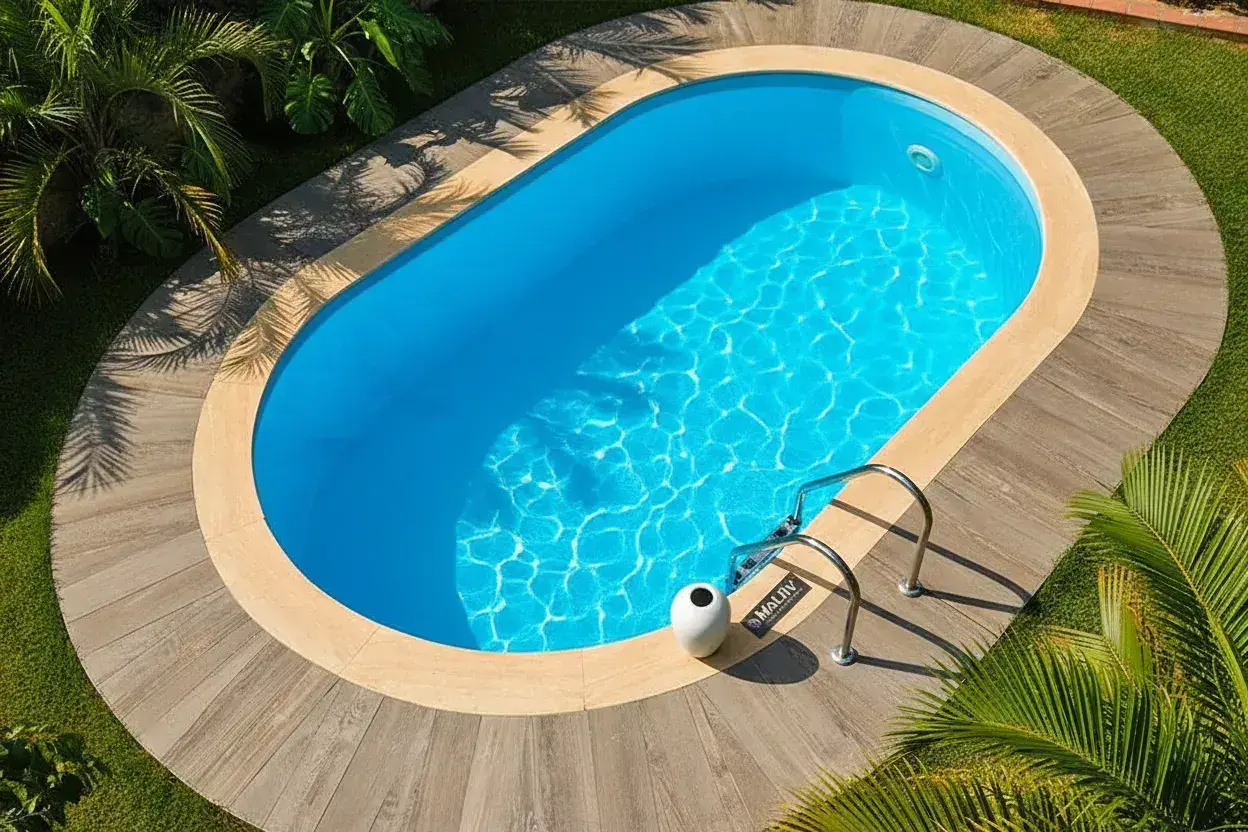 Maldiv ↗
 Bora ↗
02. Sermed Pools Base Reference Standard: C30 Strength Class, Q131 Mesh and Steel Prop Anchorage
In Sermed Pools applications, the following raft foundation slab is taken as the reference for the base detail; the thickness, concrete class and amount of reinforcement are updated according to the geotechnical investigation and the structural calculation:
- Approximately 15 cm of Compacted Crushed Stone Bedding: The washed aggregate laid on the excavation base helps reduce capillary water movement and distributes the load more evenly.
- Q131 Steel Mesh Reinforcement: Q131 steel mesh (Ø5 mm, 150×150 mm grid) set on plastic spacer blocks carries tensile and bending stresses and helps control cracking.
- A Net 20 cm of C30 Class Ready Mixed Concrete: C30 class ready mixed concrete from the batching plant (characteristic compressive strength 30 MPa) is placed with a mixer truck and pump, compacted with a vibrator and screeded to a laser level.
- Anchorage of the Steel Props: The frame props are fixed to the cured concrete slab with suitable dowels and anchors, so that the shell and the base form a system that works together.
03. Comparative Strength and Risk Table for Base Substructure Methods
The table below is a general comparison framework; actual performance depends on the soil class, the water conditions and the structural design.
| Base Construction Type | Load Bearing Capacity | Risk Level on Damp/Clayey Soil | Warranty Status | Long Term Expectation |
|---|---|---|---|---|
| Compacted Sand / Aggregate Only | Very Low (risk of point sinking) | High | May fall outside the written warranty | Loss of level may be seen early on |
| 5–10 cm Unreinforced Blinding Concrete | Low (cracks under tensile stress) | High (cold joint failure) | Risky / may be out of scope | Base cracking and settlement may be seen |
| Sermed 20 cm C30 + Q131 Mesh (reference detail) | High (raft slab acting together) | Clearly reduced risk | Conditional written warranty of up to 25 years on the Fiplus shell and up to 10 years on the Maldiv/Bora casing | Controlled settlement and long lasting level stability |
Conclusion: Reinforced base concrete of a suitable thickness is the fundamental engineering measure that allows a pool to keep its level and serve for many years. The scope and duration of the warranty depend on the product family and on the written warranty conditions.
Frequently asked questions
Why does placing only compacted sand or blinding concrete under a prefabricated pool create a settlement risk?
On damp soils with low bearing capacity, the frame props carrying tens of tonnes of water weight can crush sand or weak blinding concrete when there is no slab to distribute the load. The pool can then lose its level and the base lining can be damaged. The degree of risk is determined by a geotechnical investigation.
How many days should you wait after pouring C30 concrete before installing the pool?
The waiting time depends on the air temperature, the curing conditions and the concrete mix. In warm weather, surface work may be possible within a few days; however, for anchorage and for installation steps that transfer load, the person responsible for the application must confirm that the concrete has reached sufficient strength. No guaranteed period is given.
What happens if power float troweling is not carried out?
Sharp gravel tips or undulations left on the concrete surface can be felt beneath the liner and can strain it; the base should therefore either be power floated or corrected with a thin levelling screed.
Is the cost of the base concrete included in the pool package?
The base concrete and the excavation works are local site and construction items; they are determined by quantity take off according to the condition of the plot and local ready mixed concrete prices, and they are shown separately in the written quotation.